
Quick Links
ToggleIf you’re starting a cloud kitchen in India, the food is the fun part. The paperwork is not. But before your first order goes out the door, there’s one thing you genuinely can’t skip: getting an FSSAI license for your cloud kitchen. A cloud kitchen is still a food business in the eyes of the law, and cooking food to sell without the right registration is a serious matter. Operating without a valid FSSAI license can carry a fine of up to ₹5 lakh under the Food Safety and Standards Act, no matter how good your biryani is.
The good news is that it’s more straightforward than most people fear, and in 2026 it actually got simpler for small kitchens. At Zopping, we work with a lot of food businesses getting off the ground, and the FSSAI license for cloud kitchen setups is one of the first things people get anxious about. So here’s a plain-English guide to what you need, what it costs, and how to get it, with the recent rule changes that most older guides online haven’t caught up on yet.
One thing up front: this is a general guide, not legal advice, and food rules can change. Always confirm the current requirements on the official FSSAI FoSCoS portal or with a professional before you apply.
The FSSAI License for Cloud Kitchen Owners: Your One Essential
The big one is your FSSAI license. An FSSAI license for a cloud kitchen is issued by the Food Safety and Standards Authority of India, the government body that makes sure food sold in the country is safe and hygienic. Every food business has to have it, and that absolutely includes cloud kitchens.
Here’s the part people always ask about: yes, you need it even if you’re tiny. Even a home-based cloud kitchen cooking out of your own flat for delivery needs to be registered. There’s no size at which you’re exempt. If you’re cooking food and selling it, you need this. And you’ll need it anyway to list on the delivery apps, since Swiggy and Zomato won’t take you on without a valid FSSAI number.
Think of it as the single most important box to tick before you launch. Everything else, in a sense, sits on top of it.
What changed in 2026 (and why it helps small kitchens)
This is the bit worth paying attention to, because the rules changed in 2026 and a lot of the guides floating around online are now out of date.
Two big things changed. First, the turnover limit for the simplest, cheapest option, Basic Registration, jumped massively. It used to be for businesses earning up to ₹12 lakh a year. Now Basic Registration covers you all the way up to ₹1.5 crore in annual turnover. In practice, that means a huge number of small and home-based cloud kitchens that would previously have needed the pricier State License can now get by with the simpler, cheaper Basic Registration.
Second, licenses and registrations issued from April 2026 onwards now have what’s called perpetual validity. In plain terms: no more renewing every one to five years. Once you’re granted it, it stays valid. There’s a catch worth knowing, though: it’s not fully “set and forget.” You still have to pay your annual fee on time and file your annual return (the Food Safety Compliance Return, or FSCR), or your registration can be automatically suspended. So it’s less admin than before, but not zero.
If you looked into this a year or two ago and got scared off by renewal deadlines and low turnover limits, it’s worth another look. It genuinely got easier.
The three types, and which one is yours
FSSAI comes in three levels, and which one you need depends almost entirely on how much you expect to earn in a year. The turnover figures below are as per the latest FSSAI update (the thresholds revised in April 2026), so treat them as the current picture rather than something fixed forever. FSSAI can revise these limits by order, so it’s always worth confirming the latest on the FoSCoS portal.
Basic Registration is, as per the latest figures, for small businesses with annual turnover up to ₹1.5 crore. This is where the vast majority of new and home-based cloud kitchens will fall. It’s the cheapest and simplest option, and thanks to the 2026 change, it now covers far more businesses than it used to.
State License is the middle tier, for cloud kitchens with turnover between ₹1.5 crore and ₹50 crore a year. If you grow into a busy multi-kitchen operation, this is likely where you’ll land.
Central License is for the big players, turnover above ₹50 crore, or businesses operating across many states, plus importers and exporters. Most cloud kitchens won’t need this for a long time, if ever.
The honest way to pick is to make a realistic estimate of your first-year turnover and choose accordingly. Most people reading this will be starting with Basic Registration, and that’s completely fine. You can move up a tier later as you grow, and under the new rules, migration is free and doesn’t even change your license number.
What you’ll need to apply
The exact list varies a little by which tier you’re applying for and sometimes by state, but for most cloud kitchens getting Basic Registration, you’ll want to have these ready:
Proof of who you are, usually the owner’s Aadhaar and PAN card. Proof of the kitchen premises, something like a rent agreement if you’re renting, or ownership papers if you own the space, or a utility bill, along with a No Objection Certificate from the property owner if the place is rented. A couple of passport-sized photos. A list of the food categories you plan to prepare. A basic food safety plan or declaration about how you’ll keep things hygienic. And your GST details if your business is registered for GST, though very small businesses may not need this. For the higher tiers, State and Central, you’ll also typically need a kitchen layout plan.
It’s not an enormous pile of paperwork. If you’ve got your ID, your proof of where the kitchen is, and your photos sorted, you’re most of the way there. Getting these together before you start the application saves a lot of back-and-forth.
How to actually apply
The whole thing is done online, through the official FSSAI portal called FoSCoS (the Food Safety Compliance System). You don’t need to visit an office to get started.
The process, in plain steps, looks like this. You work out your license category from your expected turnover. You go to the FoSCoS portal (the official site is foscos.fssai.gov.in), sign up, and pick the right form: Form A if you’re applying for Basic Registration, or Form B for a State or Central License. You fill in your business details and upload scanned copies of your documents. You pay the government fee online. As per the latest fee schedule, that’s around ₹100 a year for Basic Registration, roughly ₹2,000 to ₹5,000 a year for a State License, and ₹7,500 a year for a Central License, though since these can be revised, it’s worth checking the current figure on the portal as you apply. Then you submit and track your application on the portal. A temporary reference number is usually generated straight away, which lets you get going while the application is processed. FSSAI may ask for clarification or, for the higher tiers, carry out an inspection. Once everything checks out, you’re issued a 14-digit FSSAI number, which you then display on your invoices, your packaging, and your digital menu on the apps.
For a straightforward Basic Registration, many small kitchens find it manageable to do themselves. If your situation is more complicated, or you’d just rather not deal with it, plenty of professional services will handle the filing for a fee. Either way is fine; do what suits your time and comfort level.
A few other things worth sorting
FSSAI is the non-negotiable one, but depending on your setup and where you are, a couple of other registrations may come into play.
GST registration becomes relevant once your turnover crosses the threshold that requires it, and the delivery aggregators will generally expect a GST number. Depending on your local municipal rules, you may also need a local trade or health license from your city authority to operate a kitchen. This varies quite a bit by city, so it’s worth a quick check with your local body. And if you take on staff, normal employment-related registrations may apply as you grow.
None of this should scare you off. For most people starting a small delivery kitchen, FSSAI Basic Registration plus GST if you cross the threshold is the core of it. The rest depends on your specific city and scale, which is exactly why checking locally matters.
Once you’re licensed: getting orders your way
Getting licensed clears you to sell. The next question is how you actually take orders, and this is where we can help.
Most cloud kitchens start out entirely on the aggregators, Swiggy and Zomato, and they’re a fine way to get discovered. But they take a sizeable commission on every order, and over time that adds up to a serious chunk of your margin. That’s why a lot of the kitchens we work with also set up their own ordering channel alongside the apps, so repeat customers can order directly and the full value of that order stays with them.
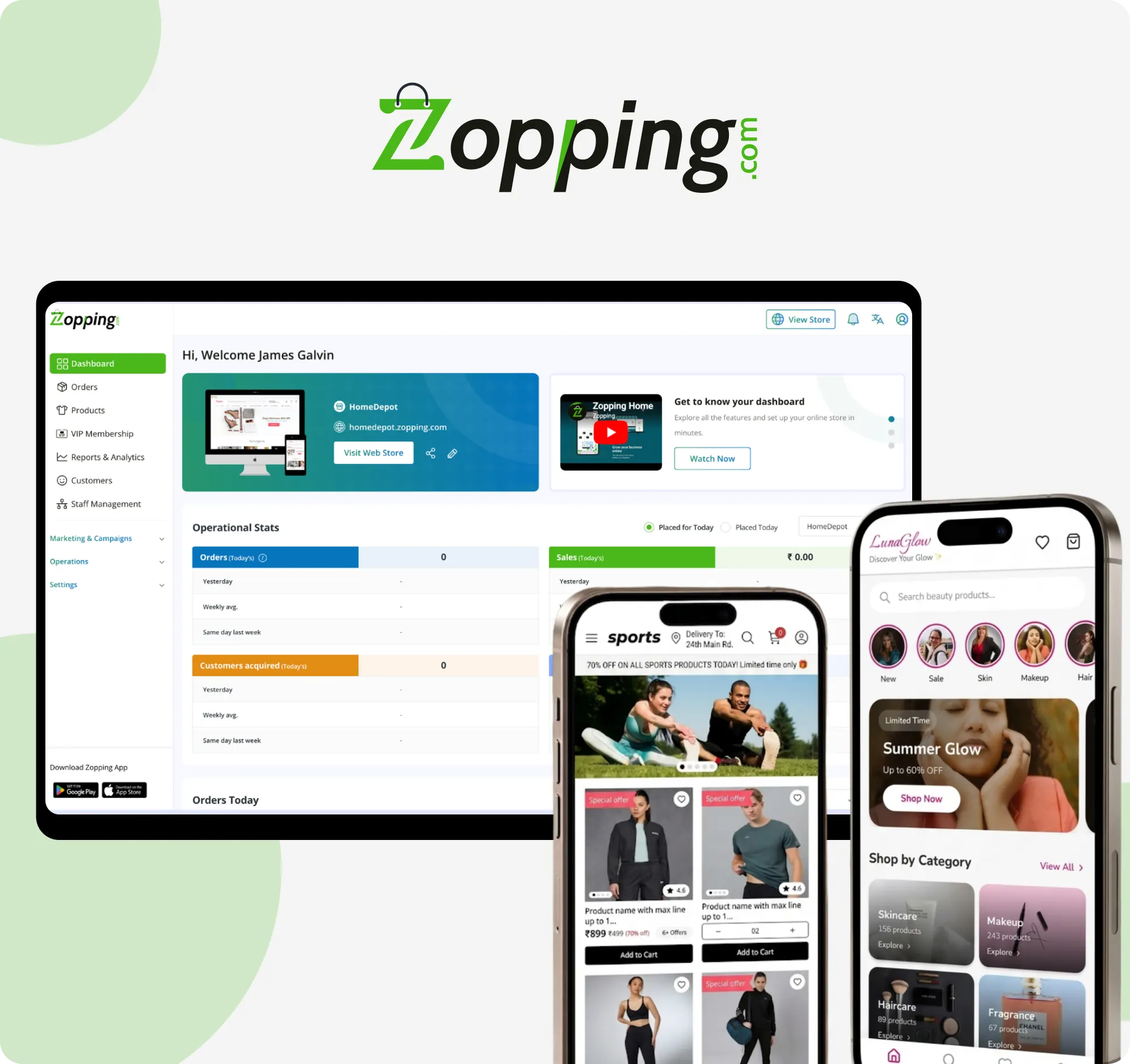
With Zopping, you can set up your own online store or ordering app for your cloud kitchen, take orders directly, manage them, and handle your own delivery zones, all from one place. It doesn’t replace the aggregators; it sits alongside them and gives you a commission-free way to serve the customers who already love your food. Once your license is sorted, our order management tools are built to handle exactly this, and if you’re weighing up why a direct channel matters, why every retail brand needs its own app makes the case in full.
Licensing feels like the boring part, but it’s the foundation everything else stands on. Get your FSSAI registration sorted first, keep it compliant, and you’re free to focus on what actually matters: cooking food people want and getting it to them. And when you’re ready to start taking orders on your own terms, we’re here to make that part simple.
Frequently Asked Questions
Do I need an FSSAI license for a home-based cloud kitchen?
Yes. There's no size exemption, and an FSSAI license for a cloud kitchen is required even for a small home operation cooking only for delivery. At minimum, you'll need Basic Registration, and you'll need a valid FSSAI number anyway to list on Swiggy or Zomato. It's the one requirement no cloud kitchen can skip, however small.
How much does an FSSAI license cost for a cloud kitchen?
The government fee depends on your category. As per the latest fee schedule, it's around ₹100 a year for Basic Registration, roughly ₹2,000 to ₹5,000 a year for a State License, and ₹7,500 a year for a Central License. If you use a professional service to file for you, they'll charge their own fee on top. Since exact fees can change, confirm the current amount on the official FoSCoS portal before applying.
Which FSSAI license do I need for my cloud kitchen?
It depends on your annual turnover. As of the 2026 rules, Basic Registration covers turnover up to ₹1.5 crore, a State License covers ₹1.5 crore to ₹50 crore, and a Central License is for turnover above ₹50 crore or multi-state operations. Most new and home-based cloud kitchens fall under Basic Registration.
Do I have to renew my FSSAI license every year?
Under the 2026 amendment, licenses and registrations issued from April 2026 onwards have perpetual validity, so there's no periodic renewal like the old one-to-five-year system. However, you still need to pay your annual fee and file any required returns on time, otherwise, your registration can be automatically suspended. So it's low-maintenance, but not zero.
How do I apply for an FSSAI license?
You apply online through the official FoSCoS portal (foscos.fssai.gov.in). In short: work out your category from your expected turnover, pick the right form (Form A for Basic Registration, Form B for a State or Central License), fill in your business details, and upload your documents (Aadhaar and PAN, kitchen premises proof with an NOC if rented, photos, a food category list, a food safety declaration, and GST details if applicable), then pay the fee and submit. You track it on the portal, and once approved, you get a 14-digit FSSAI number to display on your invoices, packaging, and menu.
Besides FSSAI, what else do I need to run a cloud kitchen legally?
FSSAI is the core requirement. Beyond it, you may need GST registration once your turnover crosses the relevant threshold (and the delivery apps usually expect a GST number), and depending on your city, a local trade or health license from your municipal authority. Requirements vary by location and scale, so it's worth confirming the specifics for your own city.