
Quick Links
TogglePull up your last order. Was it placed through a website or an app? That one habit is exactly why every retail brand needs its own app today – most of us order through apps without even noticing we’re doing it.
It’s not a coincidence. Across India’s biggest online retailers, more than 85% of all shopping traffic now comes from their apps, not their websites. The website still exists. Almost nobody uses it for repeat orders.
This isn’t about looking modern, or about waiting for “when we’re bigger.” It’s about where your customers already are – and whether you’re the one waiting for them there.
Let’s get into why, and how to actually do it without hiring a development team.
Why Your Retail Brand Needs Its Own App Today
There’s a simple truth in Indian retail right now: customers don’t browse anymore. They reorder.
Think about your own phone. How many apps do you open out of habit – not because you searched for them, but because they’re right there? That’s the exact behaviour every retail brand wants from its customers. A website gets visited. An app gets opened.
Here’s what changes the moment your retail brand has its own app:
- You’re one tap away, not one search away. A customer who needs to “open a browser, type your name, find your site” will skip half the time. A customer who taps an icon on their home screen won’t.
- You can talk to customers directly, for free. Push notifications. No ad spend, no algorithm deciding who sees it, no per-message cost. You tell your customers about a new arrival or a flash sale, and it lands on their lock screen.
- You own the customer, not the platform. On Amazon, Flipkart, or a food delivery aggregator, the customer belongs to the platform. They see your product, but they remember the app they ordered from – not your brand. On your own app, every order builds your brand’s relationship with that customer, not someone else’s.
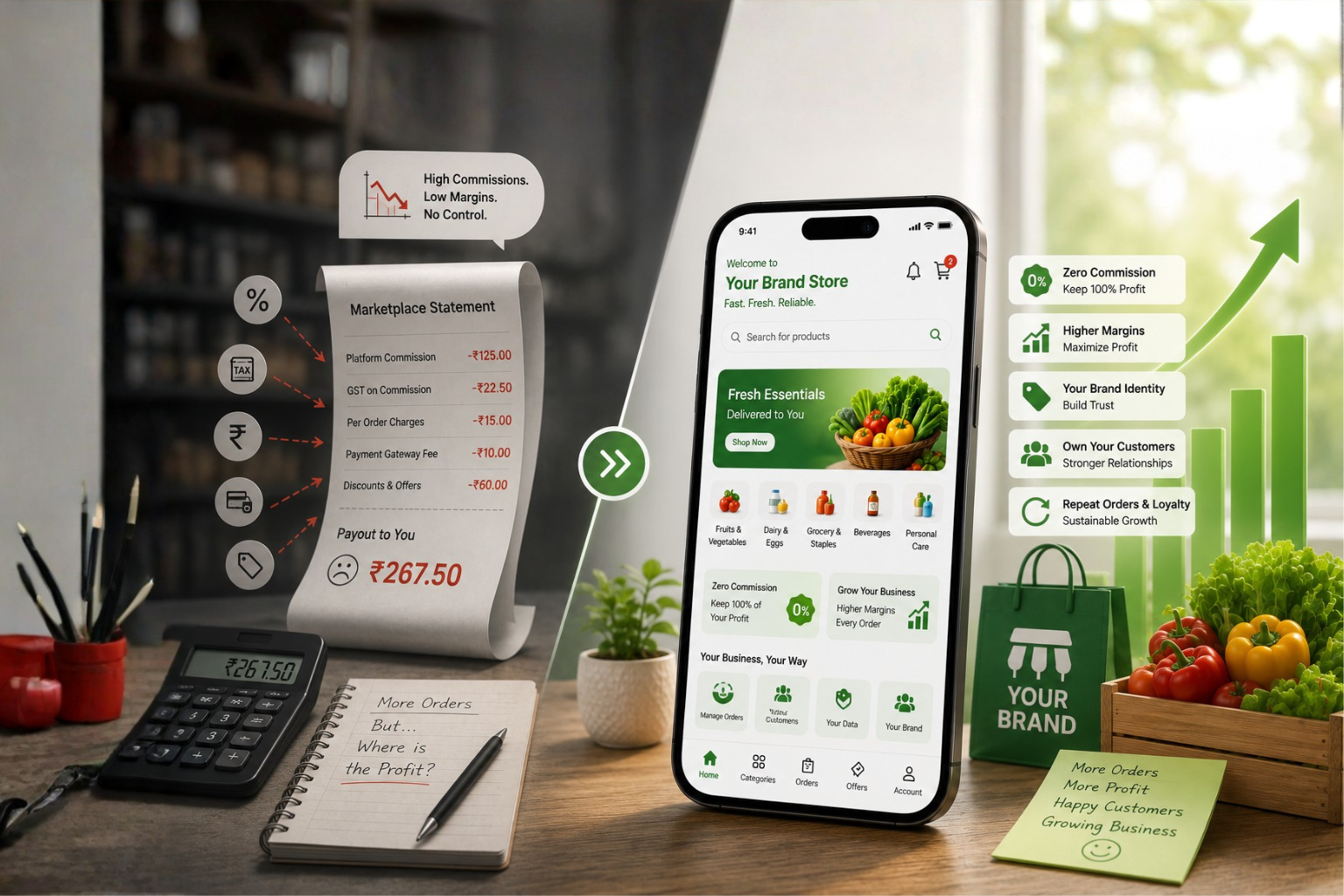
And let’s be honest about what that actually costs you. Every order that goes through someone else’s app is a customer you paid to acquire – through commission, through visibility you don’t control – and then handed over to a platform that owns the relationship instead of you. That’s not a side cost. For most small retailers, it’s the single biggest leak in the business.
- Repeat orders get easier, not harder. Saved addresses. Saved payment methods. Order history. A customer reordering on your app takes 20 seconds. The same customer reordering by searching your store fresh each time takes minutes – and many won’t bother.
- Loyalty actually works when there’s a place to put it. About 75% of shoppers say they’re more likely to buy from a brand that has a loyalty program – but a loyalty program needs a home. A points balance buried in a WhatsApp chat doesn’t feel real. The same points balance sitting on an app’s home screen does.
The Real Cost of Not Having One
It’s easy to dismiss an app as “nice to have.” It isn’t. Here’s what brands without one are quietly losing – and exactly why a retail brand needs its own app sooner rather than later.
You’re losing repeat purchases. Most online shopping behaviour today is driven by habit, not discovery. If reordering from you requires effort, customers will reorder from whoever made it effortless – even if your product is better.
You’re invisible between visits. A website only exists to the customer while they’re on it. The moment they close the tab, you’re gone from their attention until they think of you again – which, for most categories, is rare. An app sits on their phone permanently, visible every time they unlock it.
You’re paying commissions you don’t have to. If your only online presence is through Amazon, Flipkart, Swiggy, or Blinkit, you’re handing over a percentage of every single sale – and you’ll keep doing that forever, because you never built a direct channel to your own customers.
You’re behind, not even your competitors. Once a competitor in your category launches an app and starts sending push notifications, reminding customers, and making reordering effortless, the comparison isn’t close. You’re not competing on product anymore – you’re competing on convenience, and you’re starting behind.
Here’s the scale of it: 88% of Indian online shoppers now use a smartphone as their primary device for buying. That’s not a future trend you can prepare for later. That’s where your customer already is, today, while you’re still deciding whether an app is “necessary.”
What Changes Once You Have Your Own App
This isn’t about replacing your physical store or your website. An app is an additional, more direct channel – and it behaves differently from both.
| Physical Store | Website | Branded App | |
| Visibility to customer | Only when nearby | Only when searched | Permanent (home screen) |
| Reordering | Manual every time | Manual every time | One or two taps |
| Direct marketing cost | High (print, local ads) | Medium (ads, SEO) | Free (push notifications) |
| Customer data ownership | Limited | Partial | Full |
| Works offline-ish | N/A | No | Partially (cached browsing) |
The app doesn’t replace the other two. It becomes the channel your most loyal, highest-frequency customers use – the ones who already trust you and just want ordering to be fast.
Picture a neighbourhood pharmacy. A regular customer is on a monthly diabetes medication. On a website, they have to remember to visit, search, and reorder the same items every single month – and they’ll forget eventually. On an app, the pharmacy sends one push notification: “Time for your monthly refill – reorder in one tap.” That single notification, sent for free, does more for retention than any discount ever could.
Or take a grocery store gearing up for Diwali. A website sale just sits there, waiting to be discovered. An app sale lands directly on a customer’s lock screen three days before the festival – exactly when they’re already thinking about what to stock up on. The product is the same. The result isn’t.
Website vs App – Do You Need Both?
This question comes up often, and the honest answer is: yes, but they serve different jobs.
Your website (or online store) is for discovery. New customers find you through Google, social media, or a shared link. A website is open, indexable, shareable – it’s how strangers become customers.
Your app is for retention. Once someone has ordered from you once, the app turns them into a repeat customer. It’s not built to attract new people; it’s built to keep the ones you already have ordering more often.
A retail brand that only has a website is constantly fighting to re-attract the same customer every single time. A retail brand with both a website and an app attracts new customers through the website, then moves them to the app – where reordering, notifications, and loyalty programs take over. This is really the core of why a retail brand needs its own app alongside its website, not instead of it.
How to Get a Branded App Without Hiring Developers
Here’s the part that surprises most shop owners: you don’t need to hire a development team, and you don’t need to spend lakhs.
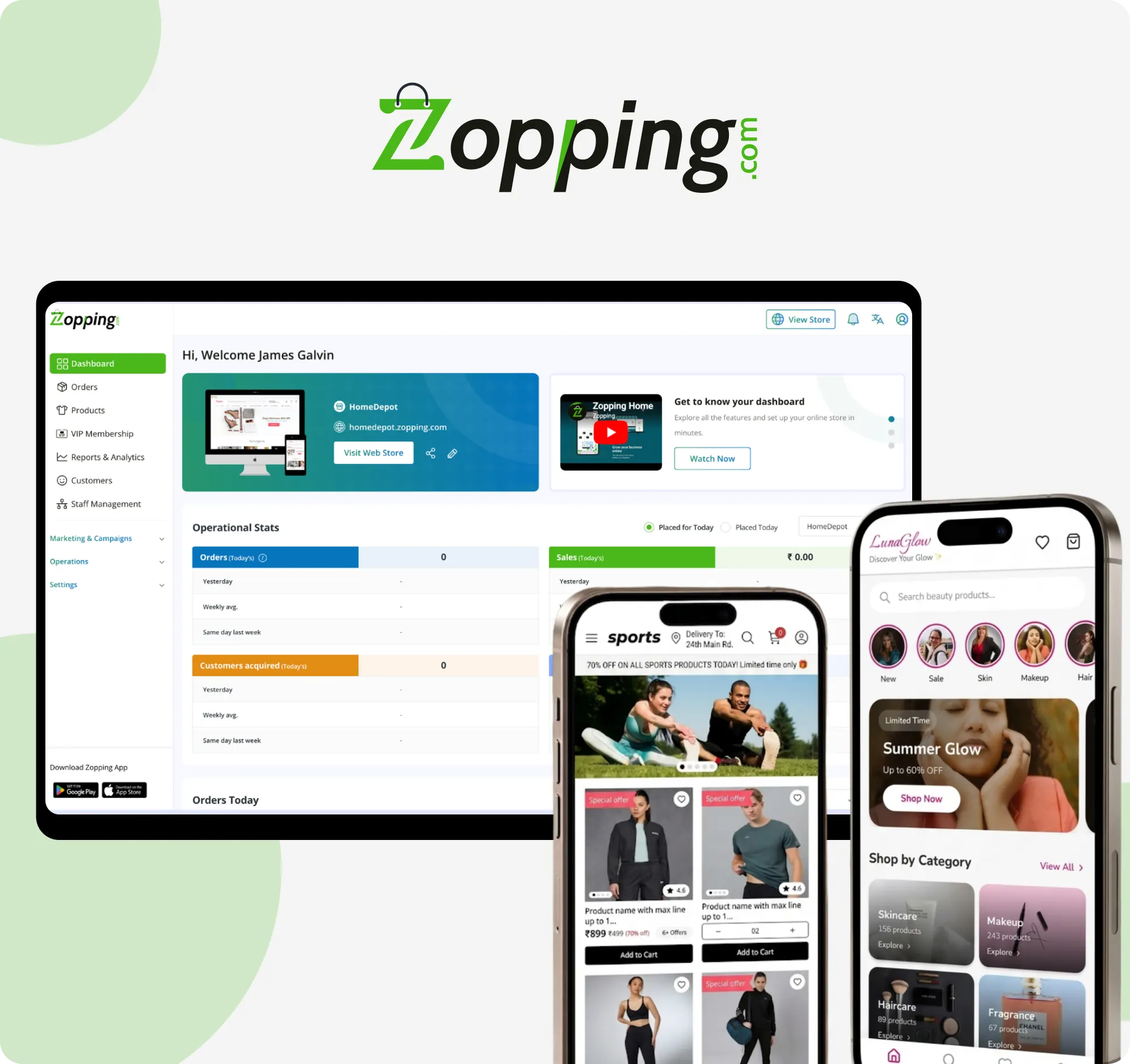
Platforms like Zopping let you launch your own Android and iOS app directly from your existing online store – without writing a single line of code. Your products, your inventory, your delivery zones, and your offers stay in sync between your website and your app automatically.
Explore Zopping’s Mobile Apps for your business →
Here’s how the process typically works:
Step 1: Set up your online store first. If you haven’t already, build your store using Zopping’s Store Builder. Your product catalogue, pricing, and store details become the foundation your app pulls from.
Step 2: Customise your app’s branding. Add your logo, your brand colours, and your store name. The app should feel unmistakably like your brand the moment it opens – not a generic template.
Step 3: Launch on Android and iOS. Zopping handles publishing your app to the Play Store and App Store, so customers can search your brand name and find you directly – exactly the scenario this whole article started with.
Step 4: Connect your delivery and payment systems. Use Zopping’s Delivery Area Management and Payment Solutions so orders placed through your app flow into the same dashboard as your website orders. One dashboard, every channel.
Step 5: Start sending push notifications. New stock, a flash sale, a festival offer – once your app is live, this becomes your most direct, free marketing channel.
What to Include in Your First App
You don’t need every feature on day one. Focus on what actually drives repeat orders:
Saved addresses and payment methods. This alone is the single biggest reason apps convert better than websites for repeat customers. Removing 5 steps from a reorder removes 5 reasons to abandon it.
Order history and easy reordering. A “reorder last purchase” button turns a 2-minute task into a 10-second one.
Push notifications for offers and restocks. Don’t overdo it – 1–2 notifications a week is enough. Overuse leads to uninstalls.
Order tracking. Customers want to know where their order is. Real-time status reduces “where’s my order” messages to your support number.
A simple loyalty or rewards element. Even something basic – points per order, a referral bonus – gives customers a reason to choose your app over reordering through a generic search. Zopping’s Rewards & Reviews tool can power this without extra setup.
Common Mistakes Brands Make With Their App
Mistake 1: Launching the app before the store is ready. Your app pulls from your existing catalogue and systems. If your product listings, pricing, or delivery zones aren’t sorted on your website first, your app inherits the same gaps.
Mistake 2: Not promoting the app after launch. An app sitting unused in the Play Store doesn’t help anyone. Add an “Install our app” banner on your website, mention it in your WhatsApp messages, and offer a small discount for the first app order to drive installs.
Mistake 3: Sending too many push notifications. This is the fastest way to get uninstalled. Stick to genuinely useful updates – restocks, real offers, order status – not a daily push for attention.
Mistake 4: Ignoring app reviews and ratings. A low rating on the Play Store or App Store directly affects how many new people install your app. Respond to reviews, fix reported bugs quickly, and ask happy customers to rate the app after a good experience.
Mistake 5: Treating the app as a one-time project. Like your website, your app needs regular updates – new offers, refreshed banners, accurate stock. A stale app feels abandoned, and customers notice.
Get Your Own App Today
Every day your retail brand doesn’t have its own app, your most loyal customers are reordering through someone else’s – or not reordering at all because it’s just easier to forget you.
Here’s the uncomfortable part: this isn’t a decision you can postpone indefinitely and catch up on later. Every month without an app is a month of repeat customers building the habit of reordering somewhere else – and habits, once formed, are hard to undo. This is, in the end, the simplest argument for why every retail brand needs its own app: not because it’s trendy, but because the alternative is slowly losing the customers you already worked hard to win.
You don’t need a development team. You don’t need months. You need your store set up, your branding ready, and a platform that handles the rest.
Launch your own branded app with Zopping →
Have questions about setting up your app? Reach out at +91 99168 14808 or book a free 30-minute demo with the Zopping team.
Frequently Asked Questions
Why does my retail brand need its own app instead of just a website?
A website works well for attracting new customers through search and social media. An app works better for keeping existing customers ordering repeatedly - it sits on their home screen, supports push notifications, and makes reordering faster with saved details. In short, every retail brand needs its own app to handle retention, while the website continues to handle discovery. Most growing retail brands eventually need both
How much does it cost to build a branded app for my store?
Building a custom app from scratch with a development agency can cost lakhs and take months. With Zopping, your app is generated directly from your existing store setup, which makes it significantly more affordable and faster to launch - often within days, not months.
Do I need coding knowledge to launch my own app?
No. Zopping is a no-code platform, so your Android and iOS app is created from the same dashboard you use to manage your online store. There's no separate technical skill required.
Will my app work on both Android and iOS?
Yes. Zopping publishes your branded app to both the Google Play Store and the Apple App Store, so customers can find and install it regardless of which phone they use.
How do I get customers to actually download my app?
Promote it where your existing customers already look - your website, your WhatsApp Business profile, your social media bio, and your physical store counter (with a QR code). Offering a small discount on the first app order is one of the most effective ways to drive the first wave of installs.
Can I manage my website and app orders from one place?
Yes. With Zopping, your website and app share the same backend - products, inventory, orders, and delivery zones stay in sync automatically. You manage everything from a single dashboard rather than juggling two separate systems.
Is having an app worth it for a small or local retail business?
Yes, especially for businesses with repeat customers - grocery, pharmacy, food, and daily essentials in particular. The cost of building one through a no-code platform is low, and the value comes from making reordering effortless for your existing customer base, not from attracting millions of new users.