

Quick Links
ToggleKey Takeaways
- Omnichannel retail creates a single, connected shopping experience across all customer touchpoints, both online and offline.
- In India, omnichannel is no longer optional. Modern customers move across channels and expect unified pricing, accurate stock visibility, and fast fulfilment.
- Data and fulfilment are the two technical problems that block most retailers. Fix those, and you unlock higher conversion, better retention and faster growth.
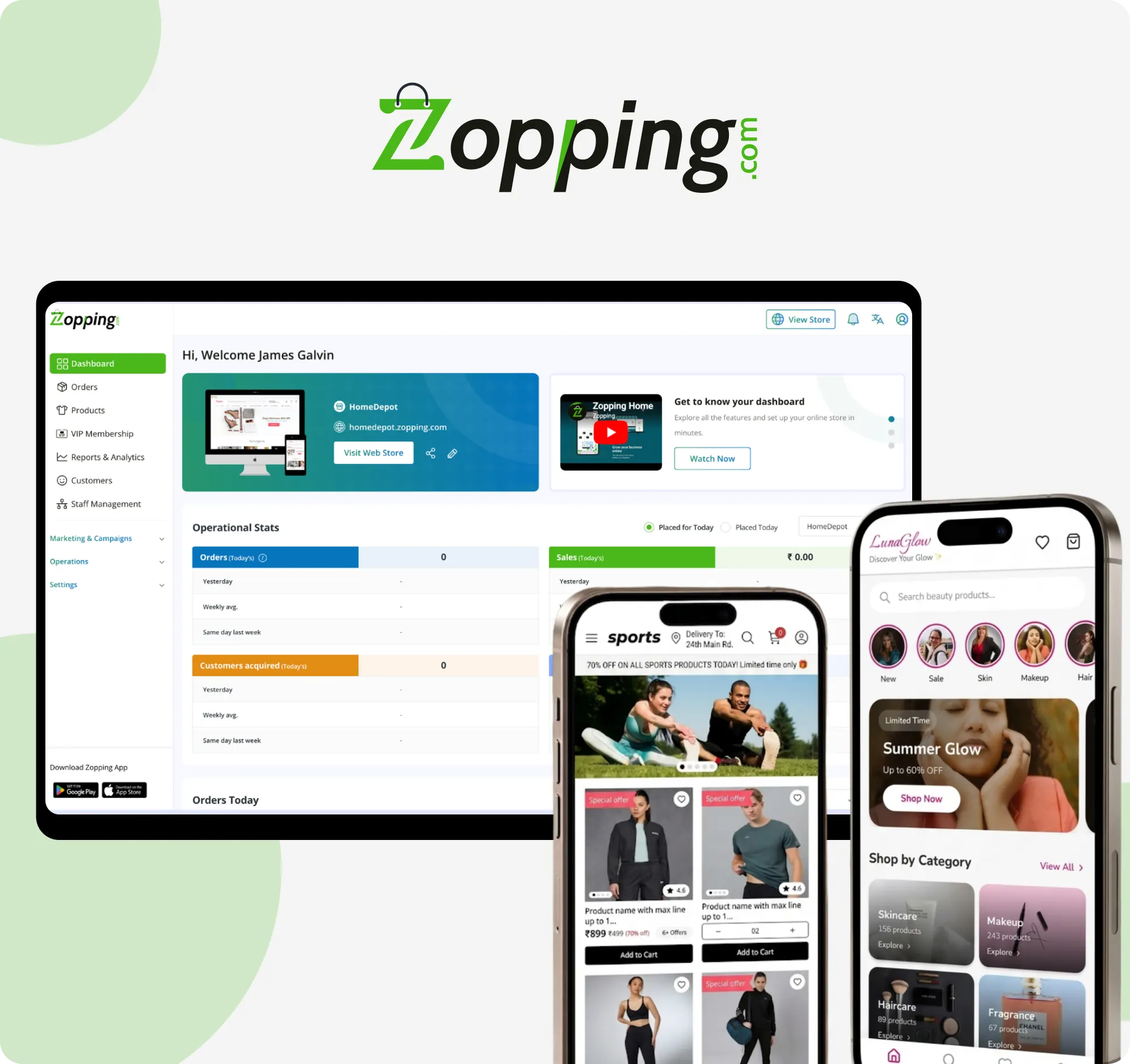
- Platforms built for India that combine zero-code setup, hyperlocal delivery, and real-time syncing let small and medium retailers adopt omnichannel faster. Zopping is an example of this approach.
Indian shoppers no longer stick to one channel. They discover products on short-form social, compare on the web, message on WhatsApp, pay via UPI, and either pick up in store or opt for fast local delivery. This behaviour is now mainstream. With over 270 million Indians shopping online in 2024, omnichannel formats have been growing considerably faster than single-channel retail.
This guide explains what omnichannel retail really is, why it matters specifically in India in 2025, how to build a practical, scalable strategy, and which technologies and KPIs matter most.
What is Omnichannel Retail?
Omnichannel retail is a customer-first approach that connects every place a shopper meets your brand. The aim is to ensure that the customer can move freely between discovery, purchase, and fulfilment without losing context. This means having the same cart, same offers, same order status, and personalisation across channels.
It is a connected model where customer data, inventory, and experience are harmonised across channels so interactions are seamless and consistent. That means systems share a common data layer, not just copies of the same information in different silos.
Key Components of Omnichannel Retail:
A working omnichannel retail model has several building blocks to create a seamless experience that customers expect:
- Unified customer profiles
- Real-time inventory
- Cross-channel order management
- Sync between POS and web
- Consistent pricing
- A fulfilment layer that can route orders to the nearest fulfilment point
Omnichannel Retail in India: What’s Changing in 2025?
Let’s see what the current landscape of the retail world in India is and how the omnichannel retail is changing now:
-
India’s Retail Landscape:
India still has millions of small, independent retailers. Many of them use separate ledgers, simple POS systems, and phone-based ordering. The opportunity for omnichannel is to unify these sellers under a simple platform so they can sell online, offer local delivery, and use store inventory for fulfilment. That consolidation is accelerating as D2C brands open stores and local retail chains adopt tech.
-
The Role of Hyperlocal Delivery:
Quick commerce (Q-commerce) and hyperlocal delivery grew massively in urban India. Bain and Company reports that Q-commerce is projected to grow at over 40% annually through 2030. Fast delivery, sometimes under 20 minutes, has become commonplace for groceries and essentials. This changes the fulfilment model: omnichannel must include store-to-door routing, dark stores, and rider networks to be effective in city geographies.
-
Changing Payment Habits:
UPI transformed payments for both online and in-store experiences. Cash on delivery (COD) and wallets remain relevant in many regions. Omnichannel systems need to reconcile payments across modes in real time and support local tax and billing rules, otherwise, reconciliation and refunds create friction for operations and customers.
Why Does Omnichannel Retail Matter More Than Ever in India?
Omnichannel retail is more than the coordination of channels. It has become a revenue and loyalty engine for small and mid-sized Indian retailers. Reports have continuously shown that connected retailers convert higher, have higher average order value, and retain customers better than siloed operators.
A well-built omnichannel experience reduces cart abandonment and improves the repeat-customer rates.
Real-World Examples:
-
Apple Retail: The Gold Standard in Channel Continuity
Apple integrates its website, app and physical stores into a single experience. Customers can:
- Reserve devices online
- Pick up from their nearest store
- Book support appointments
- Sync device configuration across channels
Every touchpoint feels familiar, consistent, and connected, making Apple a benchmark for omnichannel experience design.
-
Decathlon: Real-Time Stock + Store Fulfilment
Decathlon enables a seamless experience across:
- Website
- App
- In-store kiosks
- Warehouse + store fulfilment
Customers can check availability, reserve items, and choose between home delivery or in-store pickup. Their “endless aisle” approach ensures customers never feel limited by what’s physically on the shelf.
-
DMart Ready: Store-Led Fulfilment for Speed
DMart Ready uses a hybrid model:
- Orders are placed online
- Store/warehouse picks and packs the order
- Delivery or pickup is offered based on the area
This combines the trust of a physical retail brand with digital convenience.
In short, omnichannel is becoming the operating backbone of modern Indian retail. Not a trend, not a channel strategy, but the way customers now expect brands to function. And to understand how to build this foundation, it helps to first know how omnichannel truly differs from multichannel and the newer concept of unified commerce.
Omnichannel Retail vs Multichannel vs Unified Commerce: What’s the Difference?
-
Multichannel
A multichannel retailer sells through many channels, but systems do not share context. Each channel may have separate prices and stock. That leads to inconsistent customer experience and missed opportunities to recover carts.
-
Omnichannel
In an omnichannel retail strategy, all channels are integrated and customers can continue journeys across them. Shared carts, centralised customer context, and consistent fulfilment rules define this model. Customers see the same inventory, offers, and order status across touchpoints.
-
Unified Commerce
This is the technical outcome behind the omnichannel promise. It is built on a single data model and platform that eliminates data duplication, centralises business logic, and provides real-time accuracy across POS, OMS, CRM, and ERP. It is the deepest, most systemic approach.
| Aspect | Multichannel | Omnichannel | Unified Commerce |
|---|---|---|---|
| Data Integration | Channel-specific silos | Centralised customer & inventory data | Single data model across systems |
| Cart Continuity | No | Yes | Yes |
| Inventory Visibility | Channel-level | Unified, near real-time | Real-time with composable architecture |
| Personalisation | Per-channel | Cross-channel | End-to-end unified profiles |
| Tech Approach | Point solutions | Integrated stack | Composable/unified platform |
How to Build an Omnichannel Retail Strategy
Below is a step-by-step playbook you can implement for adopting an omnichannel retail strategy with limited upfront investment and scale as you go.
Step 1: Understand the Customer Journey & Identify Key Segments
The first step begins with mapping every discovery, research, and purchase path your customers take. This includes everything from short-form video discovery to in-store impulse buys. Then, it’s time to segment your audiences.
Segmentation helps you decide where to invest first: high-value customers might get personalised offers, and occasional buyers get basket-based incentives. Use behavioural segments, not just demographics.
Actionable start: Run a 30-day audit to list the top five journeys and channel touchpoints. Prioritise the journey that drives the most revenue or has the largest drop-off.
Step 2: Turn Every Customer Touchpoint Shoppable
Enable catalogue and checkout capabilities on social, web, app, and messaging channels. Customers should be able to save items across channels and resume buying without friction.
Actionable start: Enable a product feed for Instagram and implement a simple “send to WhatsApp” flow for store staff to reply quickly.
Step 3: Connect Your Systems
Connect systems so the customer and order context flows everywhere. A central CDP gives you unified profiles and consent management. An OMS reconciles orders against real stock and decides the fulfilment source. An API-led integration is the practical way to do this without replacing every system at once.
Actionable start: Pick one integration, POS-to-OMS or website-to-OMS, and make it reliable. Measure reconciliation accuracy.
Step 4: Build Flexible Fulfilment Options
To build a perfect omnichannel retail strategy, this step shouldn’t be missed. Offer flexible fulfilment:
- Buy online, pick up in store
- Buy online, return in store
- Ship from the store
- Promise next-day delivery
Actionable start: Pilot BOPIS (Buy Online, Pick Up In Store) in high-density urban stores with staff training and simple routing rules.
Step 5: Continuously Test, Measure & Improve
Use A/B tests for checkout flows, measure cohort retention, and track lifecycle KPIs. Continual optimisation with clear KPIs distinguishes a strategic omnichannel retail program from a tactical rollout.
Core Tech Stack & Capabilities
- Customer Data Platform/CRM: Think of this as the single sheet where every customer’s interactions live. It holds consent and basic profile, plus purchase history and channel preferences. This is the backbone of personalisation.
- Order Management & Inventory Sync: OMS decides where an order should be fulfilled from and keeps stock accurate across stores, web, marketplaces, and apps. Real-time availability avoids cancellations and bad customer experiences.
- POS & Store Enablement: Enable staff to see online carts, reserve items, and scan barcodes to update inventory instantly. This converts stores into fulfilment centres and helps with endless aisle selling.
- API-Led Integration & Composability: APIs connect these components without replacing your legacy systems. It allows modular upgrades and makes future integrations faster.
- Personalisation & Analytics: Use first-party data with simple AI to recommend products, predict demands, and personalise promotions. Customers respond well to relevant recommendations and timely offers delivered via app notifications or WhatsApp.
KPIs & Measurement Framework
When working on an omnichannel retail strategy, it’s important to constantly keep an eye out for what’s moving the business. Below are some of the important KPIs to track:
- Conversion Rate: This is tracked by channel and journey.
- Average Order Value (AOV): To test bundling and cross-sell.
- Cart Abandonment: For measuring entry points and friction in checkout.
- Customer Lifetime Value (CLV): Helps in segmenting the audience by acquisition channel and repeat behaviour.
- Net Promoter Score (NPS) / Customer Satisfaction Score (CSAT): Measures experience across channels, not just after delivery.
Use Cases of Omnichannel Retail Strategy for Small Indian Retailers
If you’re still trying to grow your small business and are new to the omnichannel retail approach, here are some use cases that can help you get started:
-
For Kirana Stores: WhatsApp Ordering + Hyperlocal Delivery
Offer a WhatsApp number for orders. Sync inventory to show what is available and promise 30-60 minute delivery from the nearest store. Use rider routing to deliver efficiently.
Why it works: Indian customers already use WhatsApp, so the conversion friction is low.
-
For Clothing Boutiques: Instagram Catalogue + Store Sync
Tag products on Instagram and link direct checkout to your website. Ensure the website reflects in-store availability. Offer reserve-in-store for high-touch items.
Why it works: Social discovery becomes immediate commerce.
-
For Pharmacies: Reserve Online, Pick Up in 10 Minutes
Allow customers to search for a medicine online, reserve it, and pick it up in ten minutes from a nearby counter.
Why it works: Urgency and trust beat pure convenience.
-
For Home Décor Stores: Virtual Catalogue + Scheduled Delivery
Offer rich catalogues with room-view examples and booking for delivery time slots. Use the store for fulfilment when inventory is local.
Why it works: Customers value inspiration plus certainty on delivery slots.
Common Challenges in Omnichannel Retail Strategy & How Zopping Solves Them
Many omnichannel efforts stall because of operational gaps. Below are common problems and practical fixes.
-
Siloed Data & Fragmented Stack
Disconnected POS, OMS, CRM, and ERP systems create mismatches and slow down decision-making.
How Zopping solves this: Zopping creates API-first integration, central product and inventory sync, and a real-time data layer that keeps channels in sync.
-
Lack of Staff Adoption
Another barrier in the path for a successful omnichannel retail strategy is the lack of staff enablement due to complex UIs and poor training, reducing adoption.
How Zopping solves this: We provide retail-friendly UI, guided workflows, and microlearning plus AI assistance to speed staff onboarding and daily tasks.
-
Inventory & Logistics Headaches
Handling inventory and logistics is often a headache that comes due to inaccurate stock levels, poor routing and cancellations.
How Zopping solves this: We automate everything, talk about real-time inventory federation and smart routing to the right fulfilment point and integrated logistics connectors.
-
Cost for Scalability
Retailers often fear the costs that come when tapping into the omnichannel retail world, with time invested in implementing it.
How Zopping solves this: We focus on modular rollout, ready playbooks, and prebuilt connectors to bring faster time to value and lower risk.
Zopping’s Approach to Successful Omnichannel Retail Adoption for Indian Retailers
Zopping combines practical strategy and India-first tech to help retailers move from pilot to scale quickly.
- Strategy-to-Execution Framework: Start with a small pilot (for example, one region or one product category), define KPIs and scale after early wins. This reduces risk and demonstrates ROI.
- Tech Integration Foundation: Use API-led architecture to connect POS/OMS/ERP, marketplaces and CRM/CDP. This approach avoids rip-and-replace projects and accelerates integration.
- India-First Enablement: Zopping prioritises local payments, hyperlocal delivery, regional languages, and retail workflows that reflect how Indian shops operate. AI-led personalisation and store-first fulfilment make the platform suited to India’s mix of digital-first and offline-first customers.
Ready to build a seamless omnichannel experience for your retail business?
Explore how Zopping helps Indian retailers unify stores, online channels, and hyperlocal delivery with ease.
Contact us or book a free demo todayFAQs About Omnichannel Retail
How fast can a small retailer go live with omnichannel?
A basic POS+web+inventory sync pilot can launch in about 2 to 3 weeks with prebuilt connectors. Full unified commerce is more complex but can be phased.
Can kirana stores benefit from the omnichannel retail strategy?
Yes, absolutely. Kirana stores can benefit from an omnichannel retail strategy by blending both online and offline sales to build loyalty, enhance customer experience, and increase overall sales by taking WhatsApp or web orders, using store stock for fulfilment, and offering rapid local delivery.