
Quick Links
ToggleAsk ten store owners how they handle delivery charges and you’ll get ten different answers. Some charge a flat fee on every order. Some throw in free delivery and quietly watch their margins shrink. Some copied a number off another store and never thought about it again. At Zopping, we work with retailers setting this up every day, and what we see most often is a store owner who genuinely doesn’t know whether the choice they made is helping their sales or hurting them.
That’s a problem, because your delivery charge, and the shipping strategy behind it, is one of the few things at checkout that decides whether a ready-to-buy customer actually pays or closes the tab. In India especially, shoppers watch that delivery line closely. A small fee on a small order is often enough to make someone abandon a cart they were seconds away from paying for. Get your shipping strategy right and you lift both your order size and your conversions. Get it wrong and you either bleed money on every delivery or lose sales you never knew you had.
So what’s the best shipping strategy? The honest answer is that there isn’t one single winner. There are four main approaches, each suits a different kind of store, and the right one for you depends on your margins, your order sizes, and how far you deliver. Here’s how we’d walk you through all four, when each makes sense, and how to land on the one that actually fits your store.
Why your delivery charge matters more than you think
Before comparing the options, it’s worth being clear on why this one small number carries so much weight.
Delivery cost is the single most common reason people abandon their carts. Study after study finds the same thing: shoppers fill a basket, reach checkout, see a delivery fee they weren’t expecting, and leave. It consistently comes out as the number one checkout killer, ahead of every other reason. The frustrating part, and we see this constantly across the stores we work with, is that these aren’t uninterested browsers. They wanted the product. The fee, or the surprise of it, is what pushed them away.
There’s also a psychology to it that’s easy to underestimate. Shoppers hate paying for delivery far more than they mind waiting for it. Most people will happily pick free delivery that takes a few extra days over fast delivery they have to pay for. The word “free” carries weight out of proportion to the actual rupees involved. A customer who would abandon over a ₹50 delivery fee will cheerfully add ₹150 of extra product to a cart to “unlock” free delivery. Same money, completely different reaction.
For Indian stores, this sensitivity runs even deeper. A shopper looking at a single low-value item is very aware of the delivery charge, and will often walk away rather than pay ₹60 or ₹80 to ship something cheap. That single fact shapes which of the strategies below will work for you.
The four shipping strategies, and who each one suits
Every delivery pricing approach is basically a version of one of these four shipping strategies. Here’s what each is, and the kind of store we’d recommend it for.
1. Flat-rate delivery
You charge one fixed fee on every order, no matter the size or where it’s going. A simple, honest ₹40 or ₹50 per delivery.
The appeal is simplicity. It’s easy to explain, easy to run, and customers understand it instantly. It works well when your orders are fairly similar in size and your delivery area is compact, so your actual cost per drop doesn’t swing much. For a lot of the local stores we work with, flat-rate is a sensible starting point.
The weakness is that one flat fee is never quite right for every order. On a small order, the fee feels steep and drives people away. On a large order, you might be quietly undercharging and eating the difference. And on its own, a flat fee gives the customer no reason to add anything to their basket.
2. Free delivery on everything
You build the delivery cost into your prices and show the customer “free delivery,” no conditions.
This is the strongest possible pull at checkout. There’s no fee to trigger an abandonment, and “free delivery” is a genuine draw that can win you customers over a store that charges. If your margins are healthy and your orders are usually large enough to absorb the delivery cost, this can work beautifully.
But we’d be honest with you: it’s a trap for thin-margin, small-order stores. If someone orders a single low-value item, you’re paying to deliver it out of a margin that can’t take the hit. Free delivery on everything only works when the maths genuinely supports it, and for many small stores, especially in groceries and everyday items where margins are tight and orders can be tiny, it simply doesn’t.
3. Free delivery above a threshold
You deliver free once the order crosses a set amount, and charge below it. “Free delivery on orders above ₹499.” For most stores, this is the one we’d point you to first.
It’s the best of both worlds. Small orders that would otherwise lose you money still carry a fee. Larger orders get the free-delivery reward. And crucially, the threshold actively pushes people to spend more. When shoppers see they’re a little short of free delivery, a large share of them will add another item to qualify, which lifts your average order value. We regularly see a well-set threshold grow order sizes noticeably, and it does it while cutting the abandonment that a flat fee causes on bigger baskets.
The one thing you have to get right is the threshold number, which we’ll come to. Set it well and this strategy quietly does two jobs at once: it protects you on small orders and grows your big ones.
4. Zone-based delivery
Your charge changes with distance. Customers close to you pay less or nothing; those farther out pay more.
This is the most accurate approach, because it ties what you charge to what delivery actually costs you. It fits hyperlocal stores especially well, and hyperlocal is where a lot of our stores operate, so we see this often. A delivery two streets away and one twelve kilometres out are completely different jobs at completely different costs. Charging both the same means you either overcharge the near one or lose money on the far one.
The trade-off is a little more setup, and it needs a store that lets you define delivery zones and price them separately. For a hyperlocal business, though, that effort usually pays for itself by stopping the far-flung orders from quietly draining your margins.
How to set a free delivery threshold that actually works
Since a threshold is what we’d recommend for most stores, it’s worth getting the number right rather than guessing, because guessing is exactly where we see most stores go wrong. Set it too low and you give away delivery you could have charged for. Set it too high and shoppers give up instead of adding more.
Start with your average order value, the typical amount people spend per order. You want your threshold set a bit above that, so it’s a small, achievable stretch rather than a leap. As a rough guide, somewhere around fifteen to thirty per cent above your current average order tends to work. If your average order is ₹400, a threshold around ₹500 nudges people to add a little without feeling out of reach. Push it too far above your average and you’ll find people simply give up rather than double their basket to qualify.
There’s a simple way to sanity-check the number against your costs, too. Look at what a delivery actually costs you and your margin on a typical order, and make sure the extra someone spends to reach the threshold brings in enough margin to cover that delivery. If it does, every order that hits the threshold is working in your favour, not against it.
Two more things make a threshold pull its weight. Show it clearly in the cart, so shoppers can see how close they are (“Add ₹80 more for free delivery”), because a threshold nobody notices does nothing. And revisit the number every so often. As your order sizes shift, the right threshold shifts with them.
So which shipping strategy should you pick?
Pulling it together, here’s the short version of what we’d suggest.
If you’re just starting and want simple, a flat delivery fee is a fine place to begin. If your margins are strong and your orders tend to be large, free delivery on everything can be a powerful draw. If you’re like most stores, free delivery above a well-set threshold is the strategy that protects your small orders and grows your big ones at the same time. And if you deliver hyperlocally across a real spread of distances, zone-based pricing keeps your charges honest to your actual costs. Nothing is stopping you from combining them either, plenty of the stores we work with run zone-based pricing with a free-delivery threshold sitting on top.
The one thing we’d steer you away from is what most stores do: pick a number once, on a hunch, and never look at it again. Whatever approach you choose, base it on your real order sizes and your real delivery costs, watch what it does to your sales, and adjust.
Setting this up on your store
Whichever strategy you land on, you need a store that lets you actually control delivery pricing the way you want, rather than forcing you into one rigid option. That means being able to set delivery charges, define a free-delivery threshold, and, for hyperlocal stores, draw up delivery zones and price them separately.
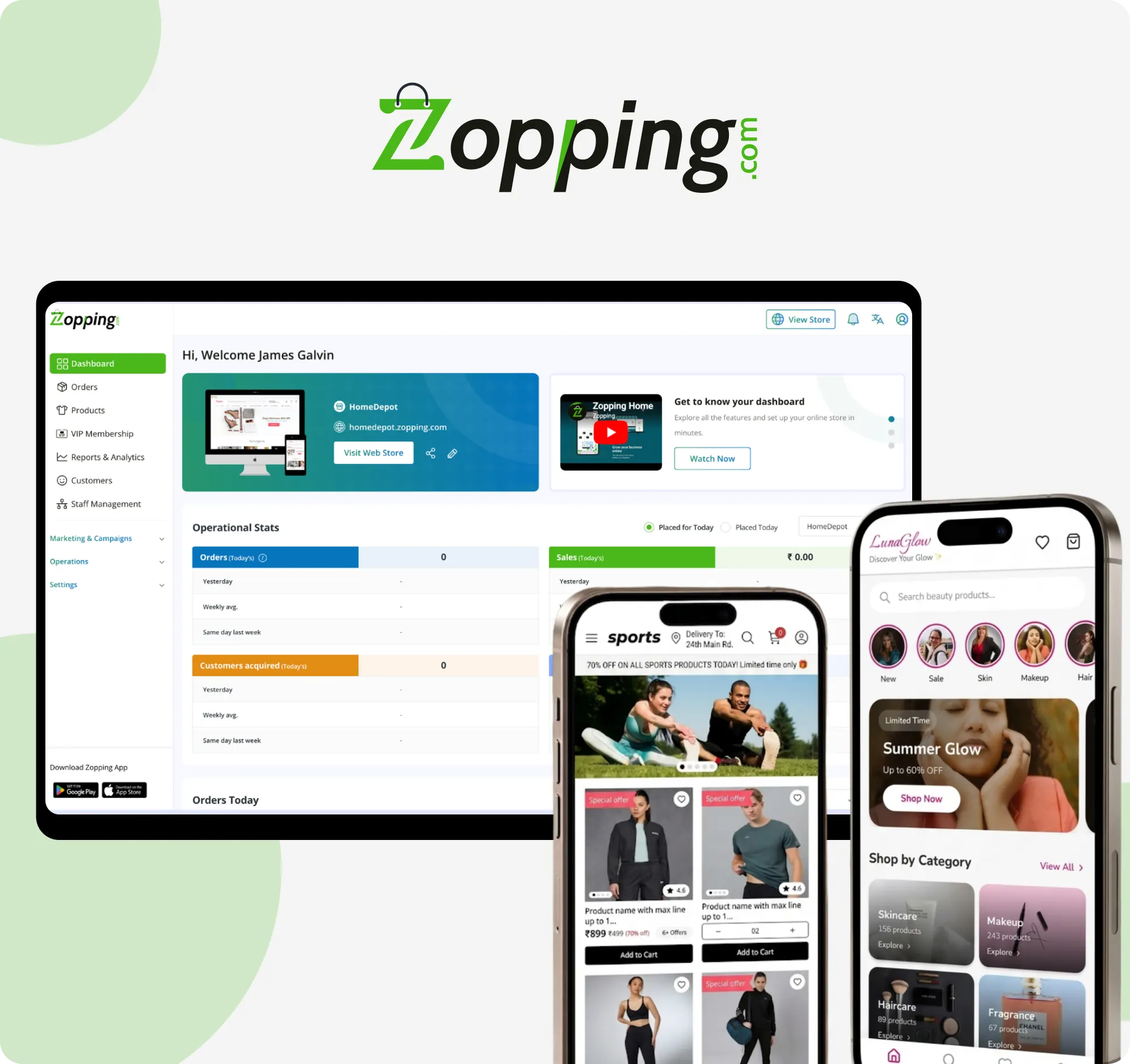
This is exactly what we built Zopping to handle. You can set your delivery charges and rules, define serviceable delivery zones and price them by area, and manage the whole thing from one dashboard alongside your orders and payments. So when you decide to test a ₹499 free-delivery threshold, or charge more for a distant zone, you can actually do it, and change it just as easily when your numbers tell you to.
To set up the areas you deliver to and how each is charged, use Delivery Area Management to map your zones, and build the free-delivery threshold as an offer through Offer Management. If cart abandonment at the delivery line is what’s worrying you, it’s worth reading how to recover abandoned carts alongside this.
No single shipping strategy fits every store. There’s the one that fits yours, the one that matches your margins, your order sizes, and your delivery area. Work out which of the four that is, set your numbers off real data instead of a guess, and keep an eye on what happens. A shipping strategy done well quietly grows your orders and your profit. Done carelessly, it’s one of the easiest ways to lose sales without ever knowing why. And whenever you’re ready to set yours up, we’re here to make it simple.
Frequently Asked Questions
Should I offer free delivery on my online store?
For most stores, we'd say yes, but tie it to a minimum order value rather than giving it away on every order. Free delivery on everything only works if your margins are healthy and your orders are usually large. If your margins are thin and orders can be small, free delivery on every order will eat into your profit. A free-delivery threshold gives you the pull of "free" while protecting you on the small orders that would otherwise lose money.
What is the best delivery charge to set for a small store?
There's no universal number, because it depends on what delivery actually costs you and how big your typical order is. A flat fee that roughly reflects your real delivery cost is a reasonable start. But rather than fixing on one charge forever, the better move for most stores is a free-delivery threshold, so small orders carry a fee and larger ones don't, which also nudges order sizes up.
How do I decide my free delivery threshold?
Start from your average order value and set the threshold a bit above it, roughly fifteen to thirty per cent higher as a rough guide, so reaching it feels achievable rather than a stretch. Then check the maths: make sure the extra a customer spends to hit the threshold brings in enough margin to cover the delivery. Show the threshold clearly in the cart so shoppers know how close they are, and revisit it as your order sizes change.
Is flat-rate or free delivery better?
Neither is better in the abstract, they suit different stores. Flat-rate is simple and works when your orders are similar in size and your delivery area is compact. Free delivery is a stronger draw but only affordable when your margins and order values support it. For many stores the best answer is actually a third option, free delivery above a threshold, which combines a fee on small orders with a free-delivery reward on larger ones.
Why do so many customers abandon their carts at delivery?
Because an unexpected or off-putting delivery fee is the single most common reason people abandon online carts. Shoppers are especially sensitive to paying for delivery, more so than to waiting for it, and in India a fee on a small, cheap order is often enough to make someone leave. Showing delivery costs early, and using a threshold that rewards larger orders, both reduce this.
Does charging by delivery zone make sense for a hyperlocal store?
Yes, often it's the fairest approach for hyperlocal stores. When you deliver across a range of distances, a nearby drop and a far one cost you very different amounts, so a single charge means you either overcharge close customers or lose money on distant ones. Zone-based pricing ties the charge to the real cost, and you can layer a free-delivery threshold on top of it.