
Quick Links
ToggleRunning a grocery business today looks very different from what it did a few years ago. Customers expect fast delivery, smooth ordering, and real-time updates. Platforms like Swiggy Instamart made that expectation common.
But here is the thing. While these platforms help you get started quickly, they also take away a lot of control from your business. Margins get tighter. Customer data stays with the platform. And over time, it starts to feel like you are building someone else’s brand instead of your own.
In this blog, we are going to take a look at why grocery businesses are moving away from Instamart, and which platforms can help you build your own branded grocery app and delivery system.
Why Grocery Businesses Are Moving Away from Instamart
Let’s be honest. Platforms like Instamart solve the “getting started” problem. But once you grow, the challenges become very real.
-
High Financial Costs and Squeeze on Margins
The biggest concern is money. Aggregator platforms charge commissions on every order. Add to that marketing costs, platform fees, and discounts, and your margins start shrinking quickly.
For grocery businesses where margins are already thin, this becomes hard to sustain. You might see good order volume, but the actual profit does not always reflect that growth.
-
Extreme Operational and Inventory Pressure
Quick commerce comes with high expectations. Customers want delivery in minutes, not hours.
This puts pressure on inventory management, staff, and fulfilment speed. If something goes out of stock or gets delayed, it directly impacts your ratings. And since everything happens on the platform, you are constantly trying to keep up with its standards rather than setting your own.
-
Data and Customer Relationship Control
When you sell through platforms, the customer is not really yours.
You do not fully control customer data. You cannot directly build relationships or run targeted campaigns without depending on the platform’s system. Over time, this limits how you grow your brand and retain loyal customers.
-
Intense Competition and Platform Bias
On aggregator platforms, you are always competing with other sellers. Sometimes even with bigger brands that have more visibility.
Platforms also control listings, rankings, and promotions. This means your business visibility is not always in your hands. Even if you offer better service, it does not guarantee better reach.
Top Instamart Alternatives in India (Platforms to Build Your Own App)
If you are serious about long-term growth, building your own ordering system starts making sense. Here are some strong alternatives that help you do exactly that.
-
Zopping
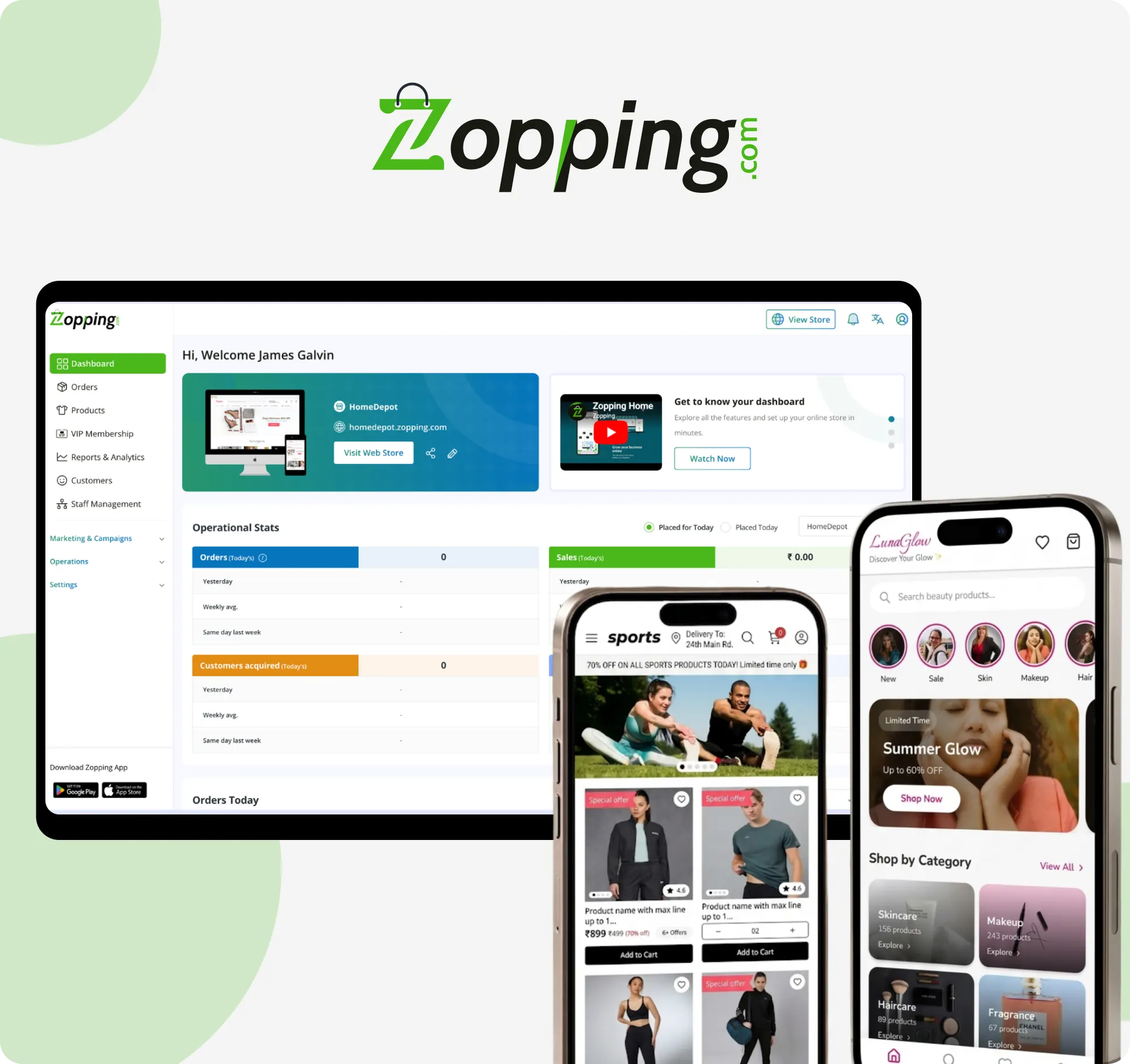
Zopping is built for grocery and retail businesses that want full control without dealing with complex tech setups. It is a no-code, all-in-one platform that lets you launch your own Instamart-style system without writing a single line of code.
What stands out here is how everything is bundled together. You get your website, mobile apps, delivery tools, and admin systems in one place. Instead of juggling multiple vendors or tools, you manage everything from a single dashboard.
For grocery businesses, this means you are no longer dependent on third-party platforms for orders. You control your margins, your customer data, and your brand experience.
Key Features
- No-code online store with admin panel, custom domain, hosting, SSL, themes, and multi-language support
- Full order management system with alerts, dashboards, live chat, returns, and abandoned cart recovery
- Multi-store support with pre-ordering, slot management, and inventory buffers
- Native Android and iOS apps along with picker and delivery apps
- Designed for non-technical users who want to launch quickly and scale easily
Pricing
Zopping offers Basic, Business, and Enterprise plans. Pricing starts at ₹4,167/month.
Read More : How Grocery Stores Can Go Online With Zopping -
Growcify
Growcify focuses on helping businesses go live quickly. You can launch your website and apps within a short time and manage everything from a single dashboard.
It works well for both single stores and marketplace-style setups.
Key Features
- No-code dashboard for managing products, orders, and inventory
- Android and iOS app launch within 24 hours
- Unlimited products, customers, and orders
- Built-in POS system with inventory sync
- Multi-language support and communication tools
Pricing
- Basic – ₹2,500 per month (billed quarterly)
- Premium – ₹4,000 per month (billed quarterly)
- Enterprise – ₹5,000 per month (billed quarterly)
-
Deonde
Deonde is a white-label platform designed for businesses that want their own ordering system without paying commissions on each order.
It is especially useful if you are planning multi-store or marketplace operations.
Key Features
- Branded website with custom domain
- Multi-vendor support on higher plans
- Delivery management with real-time tracking
- Loyalty programs and subscription features
- No per-order commission
Pricing
- Basic – ₹1,599 per month
- Pro – ₹3,999 per month
- Premium – ₹8,499 per month
App Add-ons
- Customer App – ₹34,999 one-time
- Driver App – ₹19,999 one-time
- Partner App – ₹19,999 one-time
-
Hyperzod
Hyperzod is more advanced and focuses on AI-driven quick commerce setups. It is designed for businesses that want deeper customization and automation.
It works well if you are planning to scale aggressively or build a marketplace.
Key Features
- No-code website and app builder with branding control
- AI-based product recommendations
- Merchant and driver apps for full ecosystem management
- Route optimization and delivery tracking
- Supports single store and multi-vendor models
Pricing
- Website – $29 per month
- App – $99 per month
- Merchant App – $79 per month
- Driver App – $79 per month
- Success fee – 0.99% per order
- Optional setup fee – $300 per module
-
Lokaly
Lokaly is built around local businesses that want to bring their existing customers online. It supports both individual stores and marketplace setups.
It focuses on keeping the local shop experience intact while adding digital convenience.
Key Features
- White-label solutions for grocery and other local businesses
- Customer invitation and order management tools
- Marketplace and standalone store options
- Account and customer relationship tools
Pricing
Lokaly follows a modular pricing model. Exact plan pricing is not publicly listed and is usually shared after consultation.
-
VentaGenie
VentaGenie offers a full-suite system for grocery and retail businesses. It covers ordering, delivery, and management in one place.
It is suitable for businesses with multiple delivery models or locations.
Key Features
- Branded apps for ordering and delivery
- Real-time tracking and route management
- Subscription and campaign management
- Supports hyperlocal and multi-chain setups
Pricing
- One-time setup – ₹74,999 (India)
- Unlimited orders included
- Monthly rental exists but exact pricing is not publicly listed
Why Choose Zopping
If your goal is to move away from aggregator dependency, Zopping gives you a more direct path. It focuses on making things simple without limiting your growth.
Here is how it helps in day-to-day operations:
-
Prioritise Orders Instantly
Orders are automatically sorted based on urgency, so your team knows what to fulfil first.
-
Accurate Barcode Scanning
You can verify items during picking using barcode confirmation. This reduces errors and improves order accuracy.
-
Smart Route Planning
Delivery routes are optimised to reduce delays and improve efficiency.
-
Integrated Packing Tools
Packing and label printing are handled within the system, saving time during dispatch.
-
Secure Order Handover
Orders are handed over with proper verification, reducing chances of mistakes or disputes.
All of this works together so you are not just taking orders, you are running a smooth operation from start to finish.
Ready to Go Digital? Start Selling Online with Zopping!
Closing Thoughts
Aggregator platforms are great for visibility in the early stages. But long-term growth usually comes from owning your system, your customers, and your brand.
Moving to your own platform is not just about saving costs. It is about building something that stays with you.
If you are planning to scale your grocery business and want more control over how you operate, exploring platforms like Zopping is a practical next step.