
Quick Links
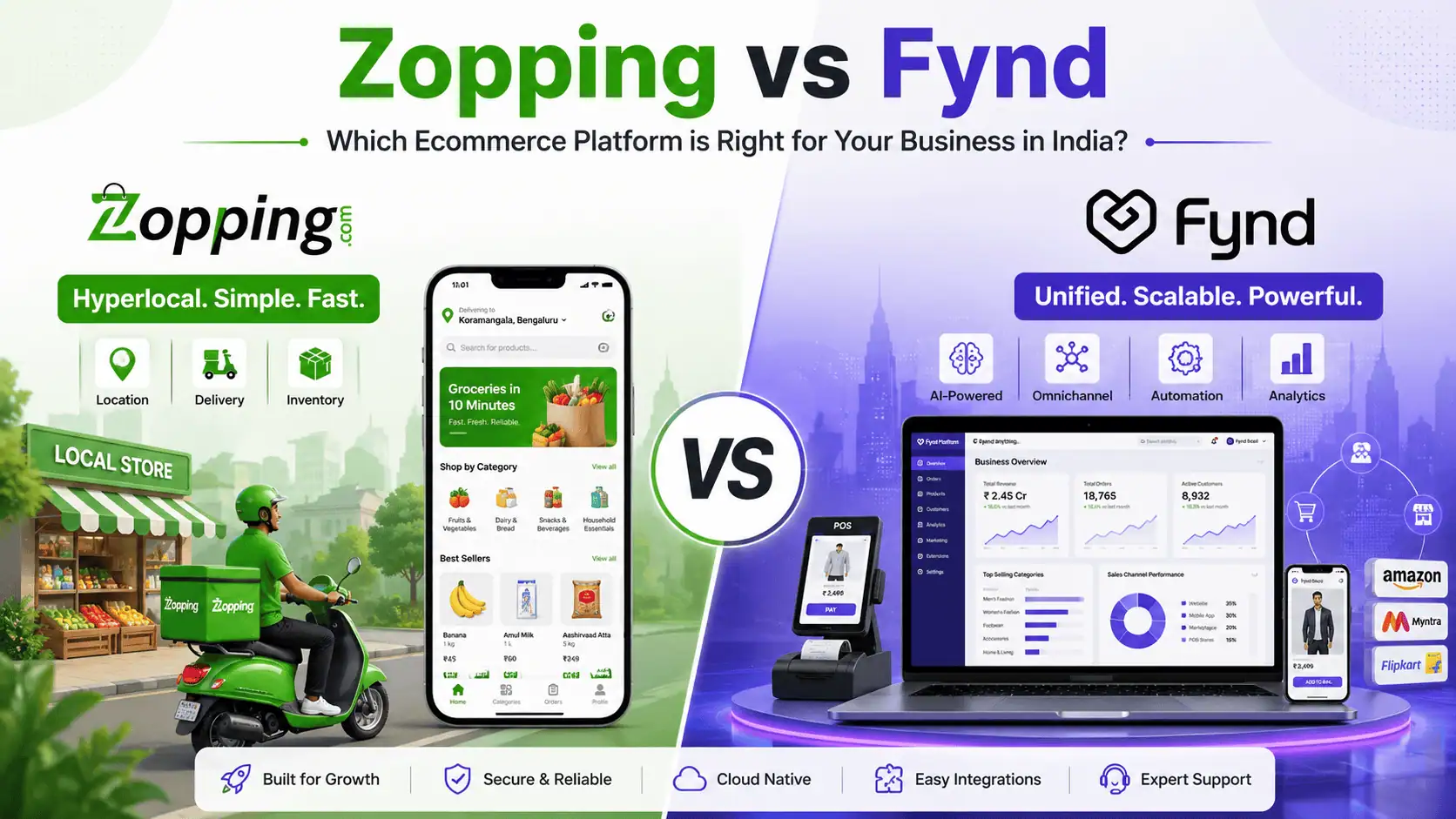
ToggleIf you are trying to choose between Zopping vs Fynd, you are likely looking at two very different approaches to commerce. In this blog, we will take a look at what each platform offers, who they are built for, and where they actually fit in real business scenarios. While Fynd focuses on unified commerce and large retail operations, Zopping is built around hyperlocal eCommerce and delivery-first businesses.
What is Fynd?
Fynd is a unified commerce platform that helps brands build online stores, manage retail operations, and sell across multiple channels. It acts as a complete backend system for retail businesses, covering everything from storefront creation to inventory, order management, and logistics.
It is widely used by brands that want to connect their offline and online operations and manage everything from one place.
Who is Fynd Built For?
Fynd is primarily built for:
-
Retail Brands and D2C Brands
If you are building a brand and want to sell through your own website, marketplaces, and social platforms, Fynd gives you the tools to manage everything together.
-
Enterprise Retailers
Large companies handling high order volumes and multiple warehouses benefit from Fynd’s ability to process heavy traffic and complex operations.
-
Physical Retail Stores Going Digital
Stores that want to connect offline inventory with online orders can use Fynd to create a seamless system where stock is shared across channels.
-
Fast Growing Startups
Startups looking to launch quickly with minimal coding can use Fynd’s tools to build websites and manage catalogs without heavy development work.
Core Strengths of Fynd
-
Omnichannel Selling
Fynd stands out when it comes to connecting different sales channels. It allows brands to sell from a single inventory across their website, marketplaces, and offline stores.
It also offers a full stack of tools including storefronts, order management systems, warehouse systems, and logistics handling. This makes it a good choice for brands that want everything under one system.
-
Supply Chain, OMS, and POS Integration
Fynd brings together inventory, billing, and order processing into one system. This is useful for businesses that operate both online and offline and want everything synced in real time.
-
AI and Automation
Fynd uses AI tools for tasks like image processing, virtual try-ons, and design assistance. These features help brands move faster and reduce manual work across operations.
Typical Business Types That Use Fynd
Fynd is commonly used by:
- Fashion brands managing large catalogs
- Enterprise retailers operating across multiple cities or channels
Limitations When Compared With Zopping
While Fynd performs well in many areas, it may not be the best fit for every business.
-
Not Built for Hyperlocal First
Fynd is designed for broader commerce, not specifically for local delivery driven businesses.
-
Can Feel Complex for Small Businesses
If you run a small store or a local business, the platform can feel heavy and harder to manage compared to simpler, focused solutions.
What is Zopping?
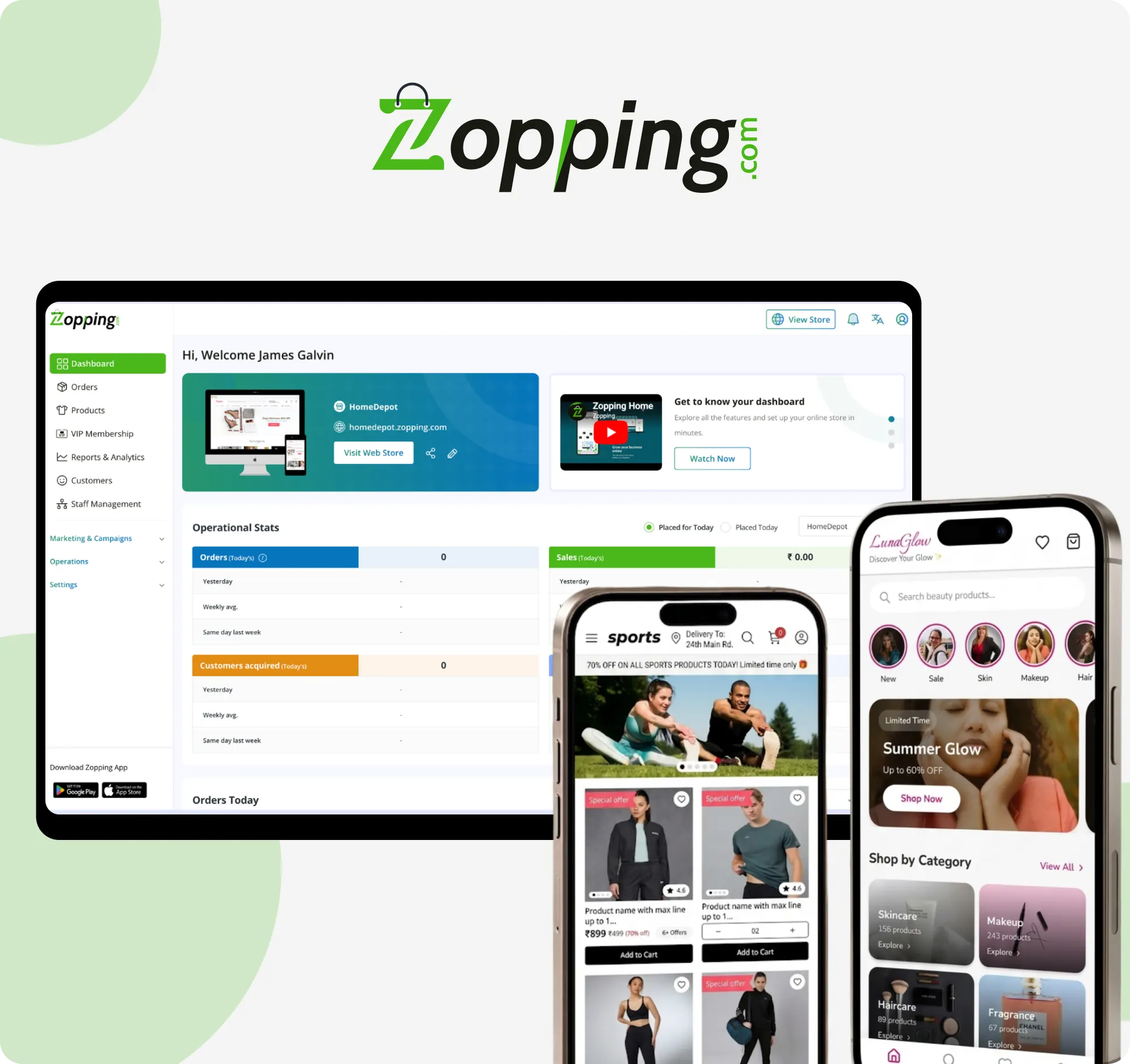
Zopping is a hyperlocal e-commerce platform built for Indian businesses.
It is designed specifically for businesses that rely on local customers and fast delivery. Instead of just giving you a website, it offers a complete system to run your online store, manage deliveries, and handle promotions.
Zopping comes with three core products:
- Zop Store for building your online store
- Zop Delivery Management System for handling deliveries
- Zop Marketing and Promotions to drive customer engagement
It is built for grocery stores, pharmacies, restaurants, fashion stores, stationery shops, and other local businesses that want to sell online without depending on aggregators.
Quick Comparison: Zopping vs Fynd
| Feature | Zopping | Fynd |
|---|---|---|
| Platform Type | Hyperlocal eCommerce platform focused on quick commerce and local delivery | Unified commerce platform that connects online, offline, and marketplaces in one stack |
| Online Store Setup | Yes, with no-code setup and ready-made templates for Indian retailers | Yes, including D2C and B2B websites for brands of different sizes |
| Hyperlocal Delivery Management | Built-in delivery management system with tools for routing, tracking, and managing deliveries | Available through logistics and transport modules but not the core focus for small local use |
| Rider / Delivery Management | Native system for assigning, tracking, and managing delivery partners | Available through logistics and TMS modules integrated with fleets and carriers |
| Delivery Radius Control | Geo-based configuration for delivery zones and serviceable areas | Supports broader routing but not focused on tight hyperlocal radius control |
| Product Catalogue Size | Suitable for medium to large catalogues like groceries and pharmacies | Handles very large, enterprise-scale catalogues with AI-powered PIM |
| Payment Gateway Options | Supports multiple Indian payment gateways and local methods | Integrates with payment providers across ecommerce and POS flows |
| Order Management Dashboard | Centralised dashboard for tracking orders and deliveries | Advanced OMS for multi-channel routing, allocation, and SLA tracking |
| Multi-location Support | Supports multi-store businesses with centralised inventory | Strong support across stores, warehouses, and marketplaces |
| Integrations & Ecosystem | Moderate ecosystem focused on local retailer needs | Extensive integrations via Fynd Konnect with ERP, WMS, POS, and more |
| Analytics & Reporting | Built-in analytics for sales and order performance | Advanced AI-powered analytics across channels |
| Marketing & Promotions | Built-in tools for campaigns, discounts, email, and SMS | Includes AI-powered engagement and messaging tools like Kaily |
| ONDC Integration | Supports ONDC use cases focused on hyperlocal commerce in India | Active ONDC integrations via seller apps and solutions |
| Aggregator Independence | High, businesses can run their own storefront and delivery | Moderate, brands often still use marketplaces alongside Fynd |
| Pricing Model | Subscription-based SaaS with free trial options for SMBs | Subscription plus enterprise pricing tiers |
| Best Suited For | Hyperlocal businesses delivering within a specific radius in India | Omnichannel and enterprise brands managing large-scale operations |
Where Fynd Has the Edge
There are situations where Fynd clearly performs better.
-
Enterprise Level Scalability
For businesses handling large volumes and complex operations, Fynd’s infrastructure is built to support that level of scale.
-
Advanced Analytics and AI
Fynd offers more advanced tools for automation, product optimization, and data analysis.
-
Larger Ecosystem and Integrations
It connects with more third party tools and marketplaces, making it suitable for brands that operate in a wide ecosystem.
Where Zopping Has the Edge
This is where Zopping stands out, especially for Indian hyperlocal businesses.
-
Hyperlocal Delivery Management Built In
You do not need third party tools to manage deliveries. If you run a local meat shop and need to handle morning orders and deliver fresh cuts within a few hours in nearby societies, Zopping lets you manage orders, assign riders, and track deliveries in one system.
-
Branded App for Your Customers
Instead of sending customers to a marketplace, you can offer them your own branded app. This helps you build a direct relationship and keep customers coming back to your store.
-
Handles Large and Complex Product Catalogues
Even if you run a grocery store with hundreds or thousands of items, Zopping allows you to manage and organize your catalog easily.
-
Delivery Zone Configuration and Order Fulfilment
You can define delivery areas, set rules for different zones, and manage how orders are fulfilled. This is useful if you serve multiple nearby locations.
-
Built for Indian Hyperlocal Commerce
The platform is designed keeping Indian business needs in mind. From local delivery expectations to customer behavior, it fits the way businesses actually operate.
-
Scales from Single Store to Multiple Locations
You can start with one store and expand to multiple outlets without changing platforms.
-
Relevant Advantage Over Fynd
If your business depends on fast local delivery and repeat customers, Zopping gives you a more focused system. You are not paying for features that you may never use.
Who Should Choose Fynd?
Fynd works best if your business looks like this:
- You are a brand selling across multiple channels like marketplaces, websites, and offline stores
- You need strong backend systems for inventory, logistics, and operations
- You are scaling fast and handling large volumes of orders
- You want advanced tools for analytics and automation
- You have the budget and team to manage a more complex system
Who Should Choose Zopping?
Zopping fits better if your business is more local and delivery focused.
- You run a grocery store, pharmacy, restaurant, fashion outlet, or similar local business
- You want to manage deliveries in house instead of relying on platforms like Swiggy or Zomato
- You want customers to order directly from you, not through aggregators
- You want your own branded app experience
- You plan to expand to multiple locations over time
- You want full control over your customer data and how you engage with them
Closing Thoughts
Both platforms solve different problems.
Fynd is built for brands that want to operate at scale across multiple channels. It focuses on backend systems, integrations, and enterprise level operations.
Zopping is built for businesses that depend on local customers and delivery. It focuses on helping you run your entire hyperlocal operation from one place without adding unnecessary complexity.
If your business is serious about building a strong local presence and owning your customer relationships, Zopping gives you a setup that matches how you actually operate day to day.
Frequently Asked Questions
What is the main difference between Zopping and Fynd?
Zopping focuses on hyperlocal commerce with built in delivery and customer engagement tools. Fynd focuses on unified commerce with strong backend systems for multi channel selling.
Is Zopping better than Fynd for hyperlocal delivery businesses?
Yes, for businesses that depend on local delivery like grocery stores or pharmacies, Zopping is more aligned with daily operations.
Can Fynd manage hyperlocal delivery?
Fynd can support delivery workflows, but it is not built specifically for hyperlocal delivery as its main focus.
Which platform is better for a grocery or pharmacy store in India?
Zopping is generally a better fit because it is designed for local delivery, catalog management, and direct customer orders.
Is there a free plan on Zopping like Fynd?
Plans and pricing can vary, so it is best to check directly with the platform. The difference usually comes down to what features are included and how they match your business needs.