
Quick Links
ToggleTo start an online business in India: (1) Choose your niche, (2) Register your business and get GST, (3) Build your online store, (4) Set up payment gateways, (5) Launch marketing. Total startup cost ranges from ₹5,000 to ₹50,000 depending on business type.
With our e-commerce market set to overtake the US by 2034, mastering how to start an online business in India might just be the smartest move you make this year. And this guide is exactly what you need to get started today!
Starting an online business in India has never been more accessible — or more profitable. With over 900 million internet users and a digital economy projected to reach $1 trillion by 2030, India offers a massive opportunity for first-time entrepreneurs and seasoned business owners alike.
But knowing where to start is the hardest part.
This guide walks you through every step of how to start an online business in India — from validating your idea and registering your business legally, to building your online store, setting up payments, and making your first sale. Whether you want to sell products, offer services, or build a D2C brand, this is the only guide you’ll need.
Here’s what you’ll learn:
- How to choose a profitable niche for the Indian market
- Business registration, GST, and legal compliance in 2026
- How to build an eCommerce store without coding
- Marketing strategies to get your first 100 customers
- Common mistakes to avoid when starting out
What Licences and Registrations Do You Need in 2026?
For an online business in India in 2026, here are the non-negotiable registrations:
| Registration | Who Needs It | Where to Apply |
|---|---|---|
| GST Registration | Mandatory for all marketplace sellers (Amazon, Flipkart, Meesho) regardless of turnover |
gst.gov.in |
| MSME / Udyam Registration | Recommended for all small businesses — free, instant, fully online | udyamregistration.gov.in |
| PAN (Business) | All business structures | incometaxindia.gov.in |
| IEC (Import Export Code) | If selling internationally or importing products | dgft.gov.in |
| FSSAI Licence | Food, grocery, health supplement businesses | fssai.gov.in |
| Shop & Establishment Act | If you have employees or a physical address | State government portal |
Important in 2026: GST registration now requires Aadhaar-based biometric verification in many states. Ensure your Aadhaar is linked to your active mobile number before applying.
MSME / Udyam Registration — Why You Shouldn’t Skip It: Registering on the Udyam portal is free and takes under 15 minutes. The benefits are significant: access to collateral-free loans under the CGTMSE scheme, Mudra Loans up to ₹10 lakh, protection against delayed B2B payments under Section 43B(h) of the Income Tax Act, and priority in government procurement tenders.
Why Start an Online Business in India?
India’s internet user base crossed 900 million in 2025, with Tier 2 and Tier 3 cities now accounting for over 60% of new e-commerce shoppers. Government initiatives like ONDC (Open Network for Digital Commerce) are further democratising online selling, allowing even small local sellers to list products across multiple buyer apps without depending on marketplace giants.
What Type of Online Business Should You Start in India?
Before diving into how to start, you need to decide what to start. Here are the most profitable online business models in India right now:
| Business Type | Investment | Best For |
|---|---|---|
| eCommerce / D2C Store | ₹10,000 – ₹1,00,000 | Selling physical products under your own brand |
| Dropshipping | ₹5,000 – ₹20,000 | Zero inventory, lower margins |
| Freelance Services | ₹0 – ₹5,000 | Designers, writers, developers |
| Online Coaching / Courses | ₹5,000 – ₹30,000 | Teachers, trainers, consultants |
| Affiliate Marketing / Blogging | ₹2,000 – ₹10,000 | Content creators |
| Reselling (Meesho, GlowRoad) | ₹0 – ₹2,000 | Beginners with no capital |
| SaaS / Digital Products | ₹20,000 – ₹2,00,000 | Developers and tech founders |
Which model is best for beginners?
If you’re starting with low capital, dropshipping or reselling on platforms like Meesho are the lowest-risk entry points. If you have a skill, freelancing has no startup cost and can generate income within days.
How to Start an Online Business in India
Let’s break down the journey of how to start your own company online, step by step.
Step 1 – Start With a Strong Foundation
-
Identify Your Niche
If you’ve ever asked, What business should I start online, start here. Think about what you’re passionate about. It can be anything, from groceries, handmade crafts, fashion, and fitness training, to digital products or services like graphic design or coaching.
But before you begin, understand the difference:
- Product-Based Businesses: You sell physical or digital products.
- Service-Based Businesses: You offer services like tutoring, web design, or consultancy.
Further, check for demand, competition, and long-term scalability. Use tools like Google Trends and Amazon Best Sellers to spot opportunities.
Start Your Online Journey With Zopping
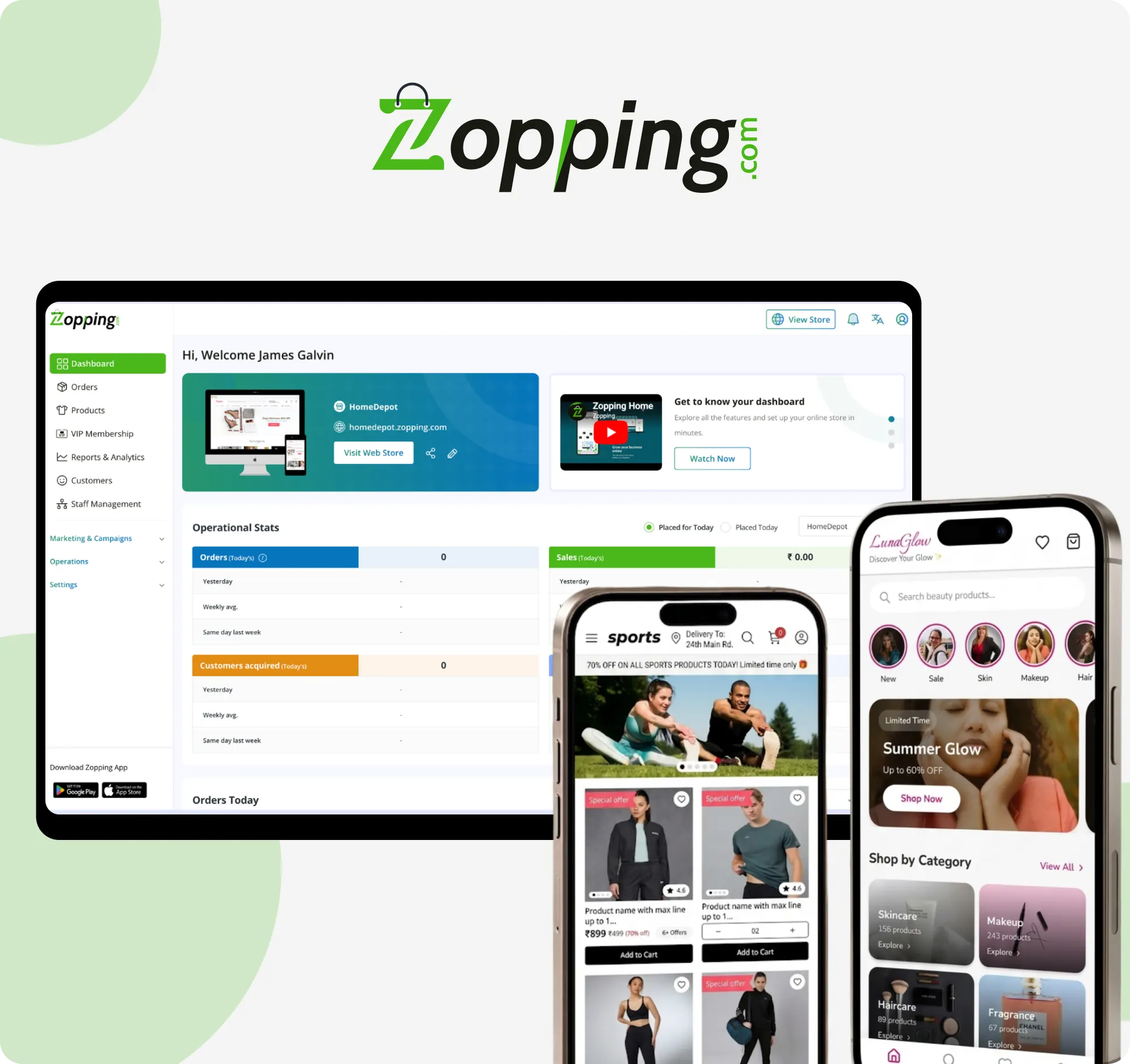
Be it groceries, fashion, electronics, or personal care, Zopping offers professionally designed, ready-to-use store themes tailored for your industry. We help you get online fast with minimal effort!
Unlock Your E-commerce Growth-
Conduct Market and Audience Research
Understanding your market is crucial. Use free tools like SimilarWeb or Ubersuggest to analyse competitors. Build customer personas by asking:
- What problems do they face?
- What do they value?
- Where do they shop online?
Knowing this helps you refine your products, messaging, and marketing.
-
Define Your Business Objectives and Unique Value Proposition
The market you want to enter might already be flooded with good businesses, but that doesn’t mean you shouldn’t step into the niche. It all narrows down to what you have that makes you different from others. Define your USP clearly.
Also, set SMART goals (Specific, Measurable, Achievable, Relevant, Time-bound). For instance, “Gain 100 customers in 90 days” is a clearer target than “Grow quickly”.
Step 2 – Look Into the Legal and Structural Setup
-
Choose a Suitable Business Structure
When figuring out how to start your own business online, you need to pick the structure that suits you the best. Below is a brief comparison table of business structures and who they are ideal for:
| Business Structure | Ideal For | Compliance | Taxation |
|---|---|---|---|
| Sole Proprietorship | Solo entrepreneurs | Low | Moderate |
| Partnership | Small teams/friends | Moderate | Shared |
| LLP / Pvt Ltd | Startups and scalable businesses | High | Low (with benefits) |
-
Register Your Business
One of the top legal questions that arises when starting a digital business is how to register an online business. Here’s how:
- Go to MCA and register your company.
- Get PAN, TAN, and if applicable, GST registration.
- Register on Startup India to access incentives.
-
Open a Business Bank Account
Another legal requirement to look out for when starting an online business is opening a separate bank account for your business. For that, you’ll need your registration documents, PAN, and address proof.
An additional tip is to choose a bank that supports startups with online banking, low fees, and integration options.
Step 3 – Dive Into Financial Planning and Compliance
-
Estimate Budgeting and Business Forecasting
How much does it cost to start an online business in India? That depends on your business model. Expenses include:
- Domain: Around ₹100 to ₹6,000 each year.
- Hosting: Around ₹200 to ₹500 every month.
- Website Setup:
- DIY website development: ₹5,000 to ₹50,000
- Freelancer-built websites: ₹10,000 to ₹50,000
- Agency-developed solutions: ₹15,000 to ₹3,50,000+
- Digital Marketing: ₹5,000 – ₹50,000/month
- Business Registration: ₹5,000 – ₹30,000
-
Accounting and Bookkeeping
When starting an online business, managing the accounting aspect is crucial to avoid any financial mistakes. You can use tools like QuickBooks and Zoho Books to manage invoices, track expenses, and file taxes on time.
-
Taxes and Legal Compliance
Managing a business is tricky, especially handling the financial and legal parts.
A business owner should be extremely aware of all the taxes and legal compliances, such as filing GST returns monthly or quarterly, paying income tax based on profits, and preparing for annual audits.
Step 4 – Build Your Online Presence
In 2026, ONDC (Open Network for Digital Commerce) is one of the biggest opportunities for Indian online sellers. By registering on ONDC, your products become discoverable across multiple buyer apps — without paying the heavy commission fees of traditional marketplaces. Alongside this, WhatsApp Business Catalogues and Instagram Shopping have become powerful zero-commission selling channels for D2C brands.
-
Secure a Domain Name and Hosting
Pick a short, brandable domain. Use services like GoDaddy, Hostinger, or Namecheap. Ensure your hosting is reliable, fast, and scalable.
-
Build a Website or an eCommerce Store
Here’s the most asked question: how to create your own online store. For that, you have two options:
- DIY Platforms like Zopping, Shopify, Wix
- Custom Development, which is usually costly and time-consuming
If you’re looking for a no-code e-commerce online store builder, Zopping offers everything from store themes to mobile apps and delivery management, perfect for startups and hyperlocal businesses!
-
Multi-Channel Selling Strategy
If you are selling products, sticking to just one channel is not enough. Adopt a multi-channel selling strategy to help you grow your business. You can sell via your website, marketplaces (Flipkart/Amazon), and social media (Instagram/WhatsApp/Facebook).
-
Set Up Payment Gateways
Choosing a reliable payment gateway partner is important so that your customers can carry out secure and hassle-free checkouts. Some popular and trusted channels include Razorpay, Stripe, UPI, Paytm, and PhonePe.
Zopping’s Secure Payment Solutions help in making the payment process easier and scalable by supporting multiple payment gateways, so your customers enjoy smooth checkouts.
Step 5 – Operations, Logistics & Marketing
-
Product Sourcing and Inventory Management
Starting an online business, especially when you are selling physical products, will require you to take care of all the logistics and operational parts. To source products and manage your inventory, you can use:
- Dropshipping: No inventory, but lower margins.
- Holding Inventory: Higher control, better margins.
-
Delivery and Fulfilment Options
Delivery is another aspect to take care of when talking about operations and logistics. There are several options for delivery fulfilment, such as Delhivery, Shiprocket, Pickrr, and more. Pick one that suits your needs and meets your goals. Moreover, set clear return policies and offer reliable delivery.
Define your delivery zones precisely with Zopping’s smart delivery management system. Get pincode-based coverage, custom area mapping, and radius-based delivery limits, all under one roof!
-
Customer Support Setup
Providing top-notch customer support is essential. Your customers are going to get frustrated and probably will never return if you do not solve their queries quickly and efficiently. Hence make sure to always have a strong customer service setup when starting an online business.
Use chatbots, WhatsApp, or tools like Zoho Desk to provide instant responses, CRM integration, and order-related support.
Step 6 – Digital Marketing: How to Get Your First Customers
Building your store is only half the work. Here’s how to drive traffic and sales:
- Search Engine Optimisation (SEO) Optimise your product pages and blog for keywords your customers search. Tools like Ubersuggest, Ahrefs, and Google Search Console help identify opportunities. Focus on long-tail keywords like “buy handmade candles online India” over broad terms.
- Google Ads & Meta Ads Paid advertising can generate sales from Day 1. Start with a small budget (₹5,000–₹10,000/month) and test Meta Ads (Facebook + Instagram) for product-based businesses. Google Shopping Ads work particularly well for eCommerce.
- Social Media & WhatsApp Marketing Instagram Reels and YouTube Shorts are the most cost-effective ways to build brand awareness organically in India. WhatsApp Business with broadcast lists and catalogues is highly effective for repeat purchases and customer retention.
- Email Marketing Build an email list from your first customer. Tools like Mailchimp (free up to 500 contacts) or Brevo let you send order updates, offers, and newsletters. Email consistently delivers the highest ROI in digital marketing.
- Content Marketing & Blogging A blog on your store helps you rank organically for product-related queries. Answer the questions your customers ask on Google — this is the same strategy that drives long-term, free traffic.
Common Mistakes to Avoid When Starting an Online Business in India
Even smart entrepreneurs make these errors. Avoid them from Day 1:
- Skipping GST Registration If you plan to sell on Amazon, Flipkart, or Meesho — GST is mandatory regardless of your turnover. Skipping it means you can’t onboard to any major marketplace.
- Ignoring Return-to-Origin (RTO) Rates On average, 30–35% of Indian eCommerce orders are returned before delivery. High RTO kills margins. Mitigate it by verifying COD orders via phone/WhatsApp and offering prepaid discounts.
- Choosing Too Broad a Niche “Fashion” is not a niche. “Sustainable cotton ethnic wear for women, size-inclusive” is. The narrower your niche, the easier it is to rank, convert, and build loyalty.
- Not Separating Business and Personal Finances Open a dedicated current account the day you register your business. Mixing personal and business money creates tax complications and makes accounting nearly impossible.
- Underpricing to Compete New sellers often underprice to get orders. Factor in marketplace commission (15–30%), shipping, packaging, returns, and payment gateway fees before setting your selling price.
- No Defined Customer Support System Even a simple WhatsApp Business account with a saved FAQ list is better than no system. Poor customer support is the #1 reason for negative reviews in Indian eCommerce.
How Much Does It Cost to Start an Online Business in India?
| Expense | Minimum Cost | Typical Cost |
|---|---|---|
| Domain Name | ₹500/year | ₹1,000–₹2,000/year |
| Hosting | ₹200/month | ₹300–₹500/month |
| eCommerce Platform (Zopping) | ₹0 (free trial) | ₹999–₹2,999/month |
| Business Registration | ₹0 (Proprietorship) | ₹5,000–₹30,000 (Pvt Ltd) |
| GST Registration | ₹0 (self-applied) | ₹500–₹2,000 (CA-assisted) |
| Logo + Branding | ₹500 (Canva) | ₹5,000–₹20,000 (designer) |
| First Inventory / Product Samples | ₹5,000 | ₹20,000–₹1,00,000 |
| Digital Marketing (Month 1) | ₹2,000 | ₹5,000–₹30,000 |
| Total Minimum | ~ ₹8,200 | ₹30,000–₹2,00,000 |
Can you start with no money? Dropshipping and freelance services have near-zero startup costs. Reselling on Meesho requires no upfront inventory investment.
Why Choose Zopping to Start Your Online Business?
Zopping is an all-in-one no-code online store builder made for Indian entrepreneurs. Right from building a customised online store, to managing payments, orders, and handling deliveries and logistics, we help you leap in the business world!
Here’s everything you get with Zopping:
- Easy Store Builder – Launch your store with stunning, ready-to-use themes.
- End-to-End Order Management – Handle inventory, orders, and payments seamlessly.
- Integrated Delivery Solutions – Deliver anywhere with smart zone mapping and courier integrations.
- Advanced Analytics – Make data-backed decisions with real-time insights.
- Secure Payments – Accept payments via UPI, Razorpay, Stripe & more.
Why Juggle 10 Tools?
Zopping simplifies the entire e-commerce journey, from storefront setup to delivery, so you can focus on how to grow your business online.
Get Started Today With ZoppingFAQs
Can I run an online business while working a full-time job?
Yes, absolutely. Running a business online can get stressful and complicated, but with the help of platforms like Zopping, you can automate your major business operations, all while also working a full-time job.
What are the best free tools to launch my online store?
Free online store builders like Zopping, WooCommerce, Wix, Square Online, and more can help you get started with the website-building part. Although their free versions have limitations when scaling your business.
Which products sell best online in India in 2025?
In India, categories like clothing products, electronics, wellness, groceries, and educational content sell the best.
How do I start an online business with no money?
If you don’t have enough money to start a full-blown business, below are some ways you can tackle this problem:
- Take advantage of dropshipping so that you don’t hold products in your inventory.
- Leverage your skills and begin creating content online or freelancing to offer your expertise without having any physical products to sell.
Which online business is best for beginners?
If you are a beginner in the online business world, businesses like freelance services, print-on-demand, reselling, or running a home-based D2C brand can be some great options.
Can I start an online business from home?
Yes, all you need is a laptop, internet, and a strong business plan.
What should I not do when starting a business?
Not conducting thorough market research, not checking legal compliances, and ignoring customer feedback are some of the few things you should not do when starting an online business.
Do I need a lawyer to start a business?
It may not be a necessity, but consulting one always proves to be beneficial for your business, especially if you are planning to start a private limited company.
What kind of business operates only on the Internet without a physical store?
Digital product businesses, dropshipping, freelance services, and SaaS companies are some businesses that can be operated without a physical store by just relying on the internet.
Is GST mandatory to start an online business in India?
GST registration is mandatory for all businesses selling on online marketplaces (Amazon, Flipkart, Meesho, etc.) regardless of turnover. For businesses selling only from their own website, GST is required once your annual turnover exceeds ₹20 lakh (₹10 lakh in special category states). In 2026, the registration process requires Aadhaar-based verification and typically takes 7 working days.
How long does it take to start an online business in India?
You can launch a basic online store in 24–48 hours using a no-code platform like Zopping. Business registration (Proprietorship or Sole Proprietorship) can be set up almost immediately. GST registration typically takes 7 working days. A fully operational business — with store, payments, legal compliance, and first marketing campaign — typically takes 2–4 weeks.
What is the best online business to start in India in 2026?
The best online businesses in India in 2026 depend on your capital and skills. For product sellers: D2C eCommerce, dropshipping, or reselling. For service providers: freelancing, online tutoring, or digital marketing consultancy. Quick commerce, health & wellness products, and regional-language content creation are among the fastest-growing categories.
Launch your online store without writing a single line of code!
Starting an online business in India has never been more accessible. Whether you're into fashion, groceries, books, or services, Zopping tailors solutions to your industry’s needs.
Book a demo with us and get your store live today!